Modern homes in Ghaziabad are changing.
Independent houses are being renovated with larger openings, builder floors are adopting cleaner architectural lines, and new villas increasingly use larger areas of glass to bring natural light into living spaces.
As architecture changes, conventional window designs are also being reconsidered.
One option that combines modern appearance with flexible functionality is the aluminium tilt & turn window.
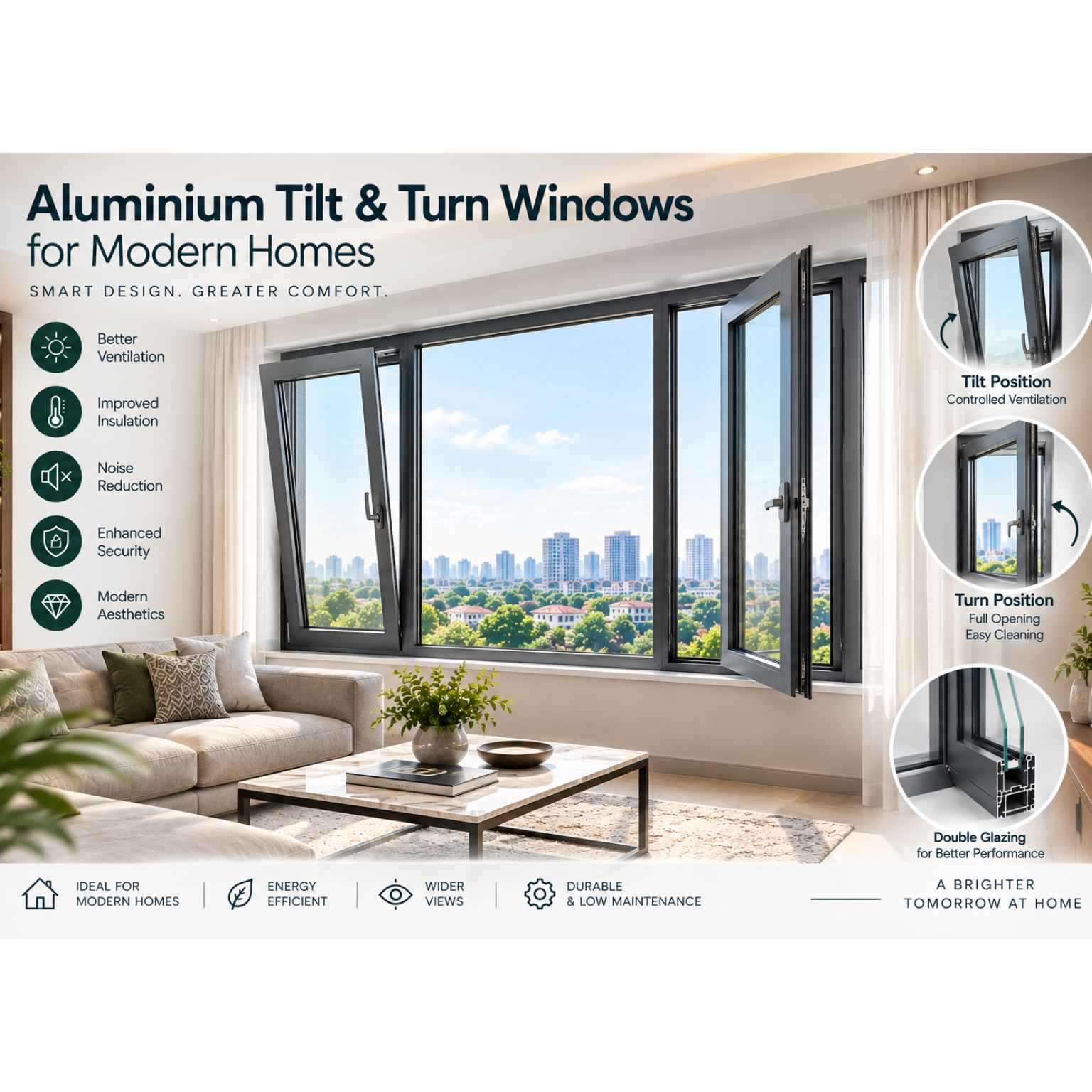
Unlike a conventional window that typically opens in one way, a tilt & turn window provides two opening modes. The sash can tilt inward from the top for controlled ventilation or open more fully inward in turn mode.
Combine that mechanism with aluminium's strength and relatively slim framing possibilities, and you get a window system particularly suited to contemporary residential architecture.
For homeowners considering aluminium tilt & turn windows in Ghaziabad, however, choosing the right system involves much more than selecting a frame colour.
Size, glass, hardware, sealing, ventilation requirements and installation all influence how well the finished window performs.
This guide explains what you should know before choosing aluminium tilt & turn windows for your home.
What Is an Aluminium Tilt & Turn Window?
A tilt & turn window is an inward-opening window operated through specialised hardware.
The same sash can usually perform two functions.
Tilt Mode
In the tilt position, the top portion of the sash moves inward while the lower part remains connected to the frame.
This creates a smaller opening near the top.
It is useful when you want controlled airflow without opening the entire window.
Turn Mode
In turn mode, the sash swings inward more fully.
This provides a much larger opening and makes the exterior side of the glass easier to access.
Together, these two operating modes give homeowners more flexibility than a conventional single-function window.
Why Aluminium Works Well for Tilt & Turn Windows
Tilt & turn systems require a frame capable of supporting the sash, glass and specialised hardware.
Aluminium is well suited to modern window engineering because it combines structural strength with relatively slim visible profiles.
Slimmer Visual Appearance
Modern architecture often favours larger glass areas and less visually dominant framing.
Aluminium can support comparatively slim profiles depending on the system and structural requirements.
This makes aluminium tilt & turn windows attractive for:
- Contemporary villas
- Independent houses
- Builder floors
- Duplex homes
- Renovated residences
- Modern living rooms
Strength for Larger Window Designs
Larger glass panels create additional weight.
Aluminium's structural properties can make it useful where homeowners want larger window openings while retaining a refined architectural appearance.
The exact sash size should still remain within the limits recommended by the profile and hardware system.
Modern Finishes
Aluminium windows can be produced in a range of finishes.
Depending on the selected system, homeowners may consider:
- Black
- Charcoal
- Grey
- White
- Bronze
- Wood-inspired finishes
- Other powder-coated finishes
This allows the windows to coordinate with the overall architecture.
Why Are Tilt & Turn Windows Useful in Ghaziabad Homes?
Ghaziabad contains a wide variety of residential properties.
The same window design that works in a compact apartment may not be ideal for a large villa.
Tilt & turn windows offer flexibility that can suit several property types.
1. Controlled Ventilation
One of the biggest advantages is the tilt function.
Instead of opening the entire window, the homeowner can tilt the sash inward from the top.
This can provide controlled ventilation in:
- Bedrooms
- Studies
- Home offices
- Living rooms
- Guest bedrooms
When more ventilation is needed, the window can be switched to turn mode.
2. Contemporary Architecture
Many renovated and newly constructed Ghaziabad homes now use:
- Larger openings
- Neutral exterior palettes
- Minimalist interiors
- Larger glass areas
- Cleaner architectural lines
Aluminium complements this style particularly well.
A tilt & turn mechanism allows the window to retain a modern visual character while adding functionality.
3. Easier Cleaning
Turn mode allows the sash to open inward.
This can make the exterior side of the glass easier to reach from inside the room.
For upper-floor bedrooms and builder floors, this is a practical advantage.
4. Flexible Glass Selection
Aluminium tilt & turn windows can be designed around different glazing requirements.
Depending on the project, options can include:
- Clear glass
- Toughened glass
- Laminated glass
- Double glazing
- Low-E glass
- Solar-control glass
The correct option depends on the room rather than simply choosing the most expensive glass.
Best Places to Use Aluminium Tilt & Turn Windows
Bedrooms
Bedrooms benefit from the flexibility of tilt ventilation.
You can use a smaller opening when limited airflow is required and turn mode when wider ventilation is preferred.
For road-facing bedrooms, suitable glazing can also help improve acoustic comfort.
Living Rooms
Living rooms are an excellent place to use aluminium's slim visual appearance.
Instead of using several small windows, a modern composition can combine fixed and operable sections.
For example:
Fixed + Tilt & Turn + Fixed
The larger fixed areas provide expansive views, while the central tilt & turn section provides ventilation.
Home Offices
A home office may require natural light and occasional ventilation without leaving a large sash fully open.
Tilt mode can work particularly well here.
Villas
Modern villas frequently use larger glass openings.
Aluminium tilt & turn windows can be incorporated alongside:
- Fixed glazing
- Aluminium sliding doors
- Corner windows
- Large living-room glazing
This can create a coordinated contemporary façade.
Aluminium Tilt & Turn Windows with Double Glazing
Double glazing can be an important addition where thermal or acoustic performance matters.
A double-glazed unit typically uses two panes separated by a sealed cavity.
This can help reduce heat transfer compared with basic single glazing.
It can also contribute to noise reduction.
However, double glazing does not work independently.
Overall window performance depends on:
Aluminium profile + glass + hardware + gaskets + fabrication + sealing + installation
For homeowners comparing windows, this complete-system approach is important.
Can Aluminium Windows Help Reduce Heat?
The answer depends heavily on the system.
Aluminium itself conducts heat more readily than uPVC.
For applications where higher thermal performance is important, homeowners can investigate thermally improved or thermally broken aluminium systems.
Glazing is also important.
Options such as Low-E or solar-control glass can be evaluated for windows receiving strong direct sunlight.
A large west-facing living-room window may need a different specification from a smaller north-facing bedroom window.
What About Noise Reduction?
For homes near busy roads or commercial areas, noise can be an important concern.
Aluminium tilt & turn windows can contribute to noise reduction when correctly specified.
Important factors include:
- Glass thickness
- Laminated glass
- Double glazing
- Cavity design
- Gasket quality
- Locking pressure
- Frame-to-wall sealing
- Installation
Avoid treating the term “double glazed” as a guarantee of soundproofing.
The entire window system determines performance.
Tilt & Turn vs Aluminium Sliding Windows
Both designs can work well in modern homes.
Sliding Windows Are Useful When:
- Inward opening space is limited
- Furniture is close to the opening
- The window is particularly wide
- Space-saving operation is important
Tilt & Turn Windows Are Useful When:
- Controlled ventilation matters
- A wider opening is occasionally required
- Easier cleaning is valuable
- Strong perimeter sealing is desired
- There is enough internal opening clearance
Many homes can use both.
Sliding windows might work well for a balcony-facing living room, while tilt & turn windows may suit bedrooms and studies.
Tilt & Turn vs Aluminium Casement Windows
A conventional casement window generally provides one primary opening action.
Tilt & turn adds a second mode.
The advantage is flexibility.
If you frequently want a smaller ventilation opening, tilt mode is useful.
If you only need a straightforward opening window, a standard casement design may be sufficient and potentially simpler.
Hardware Matters More Than Many Buyers Realise
Tilt & turn windows rely on sophisticated hardware.
The hardware must manage:
- Sash movement
- Window weight
- Tilt operation
- Turn operation
- Locking
- Compression against seals
For larger aluminium windows, hardware selection becomes even more important.
Ask your supplier about:
- Hardware specification
- Recommended sash dimensions
- Maximum sash weight
- Multi-point locking
- Handle mechanism
- Adjustment
- Replacement availability
- After-sales support
Security Considerations
Tilt & turn systems can incorporate multi-point locking.
When the window is closed, several locking points can engage around the sash depending on the hardware system.
For additional security requirements, homeowners can consider:
- Laminated glass
- Suitable security hardware
- Lockable handles
- Appropriate glazing specifications
Security should always be considered as a combination of frame, glass and hardware.
Choosing the Right Design for Your Ghaziabad Home
Single Tilt & Turn Window
Ideal for smaller openings such as bedrooms and studies.
Double Tilt & Turn Configuration
Can be used where a wider opening requires more than one operable section, subject to system limitations.
Fixed + Tilt & Turn
Excellent for modern living rooms.
The fixed glass maximises the view while the operable sash provides ventilation.
Fixed + Tilt & Turn + Fixed
A strong architectural option for wider walls.
This configuration creates symmetry and allows a larger overall glazed area.
Aluminium Tilt & Turn Windows for Renovation
Many Ghaziabad homes are being upgraded rather than rebuilt.
Renovation openings can present challenges such as:
- Uneven dimensions
- Existing steel frames
- Old wooden windows
- Damaged plaster
- Irregular sills
- Previous modifications
Proper site measurement should therefore happen before manufacturing.
The opening condition should also be evaluated to ensure the new frame can be correctly aligned, fixed and sealed.
What Determines the Price?
There is no universal price for aluminium tilt & turn windows.
Cost varies according to:
Window Size
Larger windows require more aluminium, glass and potentially heavier-duty hardware.
Aluminium System
Standard and premium profile systems can have significantly different specifications.
Glass
Single, double, laminated, toughened, Low-E and specialised acoustic glazing affect cost.
Hardware
Tilt & turn hardware is more sophisticated than basic window hardware.
Finish
Special powder-coated or architectural finishes may influence pricing.
Installation
Access, floor level, opening condition and renovation work can affect installation requirements.
What Should a Good Quotation Include?
Before comparing suppliers, check whether the quotations actually specify the same product.
Ask for:
- Aluminium profile/system
- Profile dimensions
- Glass specification
- Hardware
- Locking system
- Gaskets
- Finish
- Window dimensions
- Installation
- Frame-to-wall sealing
- Warranty
- After-sales support
A cheaper quotation may simply contain a different specification.
Why Choose JLM IMPEX for Aluminium Tilt & Turn Windows in Ghaziabad?
JLM IMPEX provides customised aluminium window solutions for residential projects across Ghaziabad and surrounding areas.
For modern homes, the window configuration can be planned around opening dimensions, architectural design, ventilation requirements, glazing, hardware and installation conditions.
This approach is especially important for tilt & turn windows because the mechanism, sash dimensions and glass weight must work together correctly.
Whether the project involves a new villa, independent home, builder floor or residential renovation, selecting the system around the actual opening can produce a more practical result than using a standard configuration everywhere.
Final Thoughts
Aluminium tilt & turn windows for modern homes in Ghaziabad offer an attractive combination of contemporary aesthetics and flexible operation.
The tilt position provides controlled ventilation.
The turn position creates a wider opening and convenient cleaning access.
Aluminium can support modern slim-profile aesthetics and larger areas of glass.
But the final performance depends on much more than aluminium itself.
Profile system, sash dimensions, glass, hardware, gaskets, locking, sealing and installation all matter.
For the best result, design each window according to the room rather than choosing one standard specification for the entire house.
Frequently Asked Questions
1. What is an aluminium tilt & turn window?
It is a window that can tilt inward from the top for controlled ventilation and open more fully inward in turn mode.
2. Are aluminium tilt & turn windows suitable for villas?
Yes. Their modern appearance and flexible configurations can work particularly well in contemporary villas.
3. Can aluminium tilt & turn windows have double glazing?
Yes, subject to the selected profile and hardware system supporting the required glass specification.
4. Are aluminium windows suitable for large openings?
Aluminium's structural strength makes it useful for many larger window applications, although sash dimensions must remain within system limits.
5. Can they help reduce outside noise?
With appropriate glass, seals and installation, they can help reduce noise transmission. They should not automatically be described as completely soundproof.
6. Are tilt & turn windows easy to clean?
The inward-opening turn function can make the exterior surface of the glass easier to access.
7. Which rooms are best for tilt & turn windows?
Bedrooms, studies, home offices and selected living-room openings are common applications.
8. Are they better than sliding windows?
Neither is universally better. Sliding windows save operating space, while tilt & turn windows offer two opening modes and strong sealing potential.
9. Can I choose black aluminium frames?
Black, grey and other finishes may be available depending on the selected aluminium system and finishing options.
10. Can tilt & turn windows be installed during renovation?
Yes, provided the existing opening is properly measured and prepared.
11. Is double glazing necessary?
Not always. It should be considered when thermal or acoustic performance is important.
12. What should I check before buying?
Check the aluminium profile, glass, hardware, sash dimensions, gaskets, locking, installation and warranty.