A balcony can be one of the most enjoyable parts of a home—but it can also be one of the most exposed.
Dust, insects, traffic noise, heat, rain and seasonal weather can limit how often you actually use the space.
This is why many homeowners consider uPVC balcony windows in Ghaziabad when building or renovating their homes.
The right balcony-window system can help create a more comfortable transition between indoor and outdoor spaces while preserving daylight and views.
But there is no single “best balcony window.”
A compact builder-floor balcony has very different requirements from a wide villa balcony.
Before choosing a system, you need to consider:
Opening width + ventilation + view + glass + mesh + sunlight + noise + drainage + maintenance.
This guide explains the major balcony-window designs and how to choose between them.
Why Choose uPVC Windows for a Balcony?
Balcony windows are more exposed to exterior conditions than many internal-facing windows.
uPVC can be useful because it offers:
Low routine maintenance
No routine repainting
Multiple opening configurations
Compatibility with different glazing options
Custom fabrication
Clean contemporary appearance
The actual performance, however, depends on the complete window—not simply the frame material.
Glass, hardware, reinforcement, seals and installation all matter.
Best uPVC Balcony Window Designs
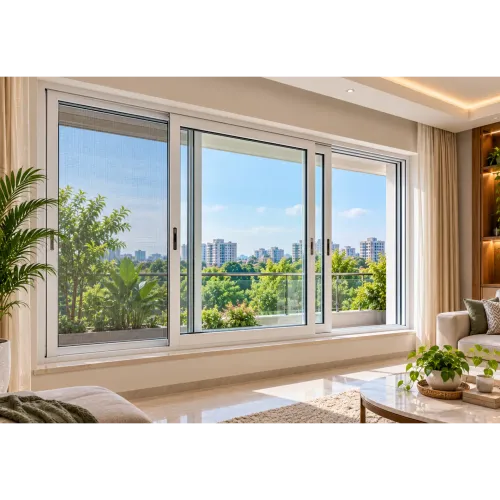
1. Sliding uPVC Balcony Windows
Sliding windows are one of the most practical choices for balconies.
The shutters move horizontally instead of swinging inward or outward.
This is useful because balcony space is often occupied by:
Plants
Chairs
Tables
Drying racks
Storage
Decorative items
A sliding window does not require conventional swing clearance.
It can therefore preserve usable balcony space.
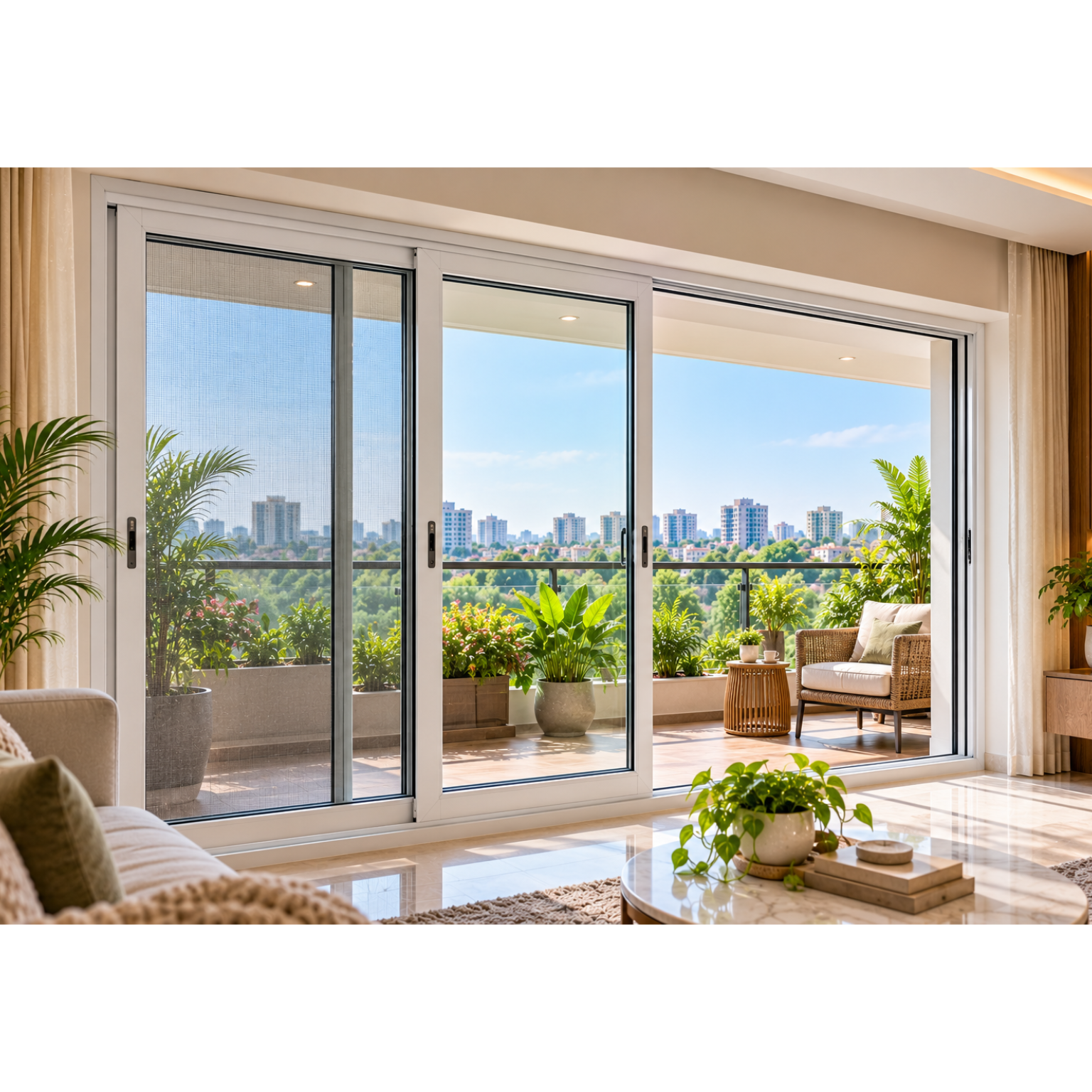
2. 3-Track Sliding Balcony Windows
For wider balcony openings, a 3-track sliding configuration can provide greater flexibility.
Depending on the system, three tracks can accommodate multiple sliding shutters or configurations involving mosquito mesh.
A 3-track system can be useful when:
The balcony opening is wide
Multiple sliding panels are required
Mesh integration is desired
You want greater opening flexibility
However, confirm the exact configuration.
“3 track” does not automatically mean mosquito mesh is included.
3. Casement Balcony Windows
Casement windows use hinged shutters.
When fully opened, they can provide a relatively broad ventilation opening.
They may be suitable where:
Balcony depth is sufficient
Exterior clearance is available
Maximum natural ventilation is important
The opening is not excessively wide
For narrow balconies, however, sliding windows may be more space-efficient.
4. Fixed + Sliding Combination
Suppose you have a wide balcony opening and want an uninterrupted view.
You don't necessarily need every panel to move.
A configuration such as:
Fixed | Sliding | Sliding | Fixed
can provide broad glass areas while keeping selected sections operable.
The fixed sections maximise daylight and views.
The sliding sections provide ventilation.
5. Fixed uPVC Balcony Windows
A fixed window does not open.
This can be useful where:
The priority is daylight
The view is important
Ventilation is provided elsewhere
The panel is difficult to access
For a complete balcony enclosure, however, some operable sections are usually useful for ventilation.
6. Combination Windows
Larger balcony façades can combine multiple window types.
For example:
Fixed glass + sliding windows + top ventilator
The exact design should be based on architecture rather than forcing the entire opening into one window type.
Open Balcony vs Enclosed Balcony
Before selecting windows, decide what you want the balcony to become.
Semi-Open Balcony
You may want windows primarily for:
Rain protection
Insect control
Occasional closure
Ventilation remains a major priority.
More Enclosed Balcony
You may want:
Greater separation from outdoors
Improved noise control when closed
Reduced dust infiltration
Better weather protection
The glass and sealing requirements may therefore differ.
Balcony Windows for Ghaziabad Builder Floors
Builder-floor balconies can have relatively limited depth.
This makes projecting shutters inconvenient.
Sliding uPVC windows can work particularly well because the shutters remain within the window plane.
A 2-track system may be enough for moderate openings.
For wider openings or where a dedicated mesh arrangement is desired, a 3-track system can be evaluated.
Balcony Windows for Independent Houses
Independent houses often provide more flexibility.
The balcony may face:
Garden
Road
Internal courtyard
Neighbouring house
Park
The design should respond to the exposure.
For a garden-facing balcony, clear glass and broad openings may be desirable.
For a road-facing balcony, noise and dust may be higher priorities.
Balcony Windows for Villas
Villa balconies often have wider openings.
Instead of dividing the entire opening into many narrow shutters, consider combining:
Fixed glass
Sliding panels
Larger viewing areas
This can create a cleaner architectural appearance.
What Glass Should You Choose?
The correct glass depends on the balcony.
Clear Glass
Suitable when:
Exterior view is attractive
Maximum daylight is desired
Privacy isn't a major concern
Toughened Glass
May be considered according to panel dimensions, safety requirements and location.
Laminated Glass
Can provide additional safety characteristics and may be considered where acoustic requirements are important.
Double Glazing
Can improve thermal and acoustic performance compared with basic single glazing when used within an appropriate system.
Solar-Control or Low-E Glass
May be considered for strongly sun-exposed balcony windows.
Don't select glass purely because it sounds premium.
Select it according to the problem you need to solve.
Ghaziabad Dust: Can Balcony Windows Help?
When properly closed, a well-fabricated and installed uPVC window can help limit air and dust infiltration through the opening.
But avoid claims such as:
“100% dustproof.”
Sliding windows contain moving interfaces, and real-world performance depends on:
Profile design
Interlocks
Seals
Alignment
Installation
When the windows are open, outside air and dust naturally enter.
Mosquito Mesh for Balcony Windows
Mesh can be especially useful in Ghaziabad homes where balconies remain open during pleasant weather.
Depending on the window design, you can consider a compatible sliding mesh system.
Check:
Mesh material
Frame
Visibility
Airflow
Cleaning
Replacement
Track configuration
Plan mesh before fabrication rather than adding it as an afterthought.
Can Balcony Windows Reduce Noise?
When closed, suitable windows can contribute to noise reduction.
But acoustic performance depends on:
Glass + profile + seals + fabrication + installation.
If your balcony faces a busy road, tell the manufacturer that noise is a priority before choosing the glass.
What About Heat?
Balconies receiving strong afternoon sunlight can become hot.
Closing them entirely with ordinary clear glass can sometimes increase heat buildup.
Therefore, don't think only about enclosure.
Think about:
Orientation
Ventilation
Glass
Shading
Curtains/blinds
Balcony depth
For west-facing balconies, solar-control strategies may be worth considering.
Balcony Drainage Is Important
Balconies are exposed to rain.
Window installation should therefore account for water management.
Check:
Track drainage
Weep holes
Sill
Exterior slope
Frame sealing
Water should not simply collect inside sliding tracks.
Should You Use 2 Track or 3 Track?
Consider 2 Track When:
Opening is moderate
Two sliding shutters meet the requirement
Budget is important
Mesh doesn't require a separate arrangement
Consider 3 Track When:
Opening is wider
More sliding panels are useful
Additional configuration flexibility is required
Mesh integration is planned
More tracks aren't automatically better.
White vs Coloured uPVC Balcony Windows
White remains versatile and works with many residential façades.
Depending on the selected profile system, other laminated finishes may also be available.
Before changing the external colour in an apartment or builder development, check façade requirements where applicable.
Security for Ground and Lower Floors
Accessible balconies require additional security consideration.
Review:
Locks
Hardware
Glass
Opening size
Anti-lift provisions where applicable
Mosquito mesh should not be treated as a security barrier.
What Determines uPVC Balcony Window Price?
The final cost depends on:
Total opening size
2-track or 3-track configuration
Profile
Number of shutters
Glass
Reinforcement
Rollers
Locks
Mesh
Finish
Installation
For very large balcony openings, the design and panel sizes can influence the specification substantially.
Balcony Window Buying Checklist
Before ordering, confirm:
Design
Sliding/casement/fixed
Number of shutters
Opening percentage
Track configuration
Glass
Type
Thickness
Safety requirement
Thermal/acoustic requirement
Hardware
Rollers
Locks
Handles
Practical Features
Mosquito mesh
Drainage
Cleaning access
Exterior sealing
Commercial
Installation
Taxes
Warranty
After-sales service
Common Mistakes to Avoid
1. Closing the Entire Balcony Without Planning Ventilation
An enclosed balcony can become hot and stuffy.
2. Choosing Glass Only by Price
Glass affects safety, heat and noise performance.
3. Ignoring Drainage
Balcony windows face rain directly.
4. Adding Mesh Later
Plan it with the original track configuration.
5. Making Sliding Shutters Excessively Large
Larger shutters become heavier and require appropriate hardware.
6. Assuming More Tracks Mean Better Performance
Choose tracks according to the configuration required.
Why Choose JLM IMPEX for uPVC Balcony Windows in Ghaziabad?
JLM IMPEX manufactures customised uPVC doors and windows for residential and commercial applications.
For Ghaziabad balconies, the window configuration can be planned according to opening dimensions, property type, view, ventilation, mesh requirements, glass and exterior exposure.
This can be particularly useful for independent homes, villas and builder floors where balcony dimensions vary considerably.
Final Thoughts
The best uPVC balcony windows in Ghaziabad should make your balcony more usable without making it feel disconnected from the outdoors.
Before choosing, think beyond the frame.
Consider:
View + ventilation + glass + mesh + heat + dust + noise + drainage + security.
Then decide whether you actually need a 2-track, 3-track, casement or combination system.
A balcony window should solve the problems of the space—not simply fill the opening.
Frequently Asked Questions
1. Which uPVC windows are best for balconies?
Sliding windows are particularly space-efficient, while casement and combination windows can work well depending on the opening.
2. Are 3-track windows good for balconies?
They can be useful for wide openings, multiple sliding panels or certain mesh configurations.
3. Can I install mosquito mesh?
Yes, compatible mesh solutions can be planned depending on the window system.
4. Do balcony windows reduce dust?
When closed, suitable windows can help limit infiltration through the opening, but they should not automatically be described as completely dustproof.
5. Can balcony windows reduce traffic noise?
Suitable glass, seals and installation can contribute to noise reduction.
6. Which glass is best for a sunny balcony?
The answer depends on orientation and performance goals. Solar-control or Low-E options may be considered for strongly exposed openings.
7. Can I use double glazing?
Yes, with a compatible uPVC system and suitable hardware.
8. Are sliding windows better than casement for small balconies?
They are often more space-efficient because they don't require swing clearance.
9. Do balcony windows need drainage?
Yes. Water management is an important part of exposed balcony-window installation.
10. Can I enclose my entire balcony?
Technically possible configurations vary, but building/society requirements should be checked before changing an external façade.
11. Is white uPVC the only option?
No. Finish options depend on the selected profile system.