Bathroom windows have to solve a combination of requirements that few other windows in the house face.
You need privacy, but you don't want the bathroom to feel dark.
You need ventilation, but you may not want a large unrestricted opening.
You want a window that works well in a moisture-heavy environment, but it should also complement modern bathroom interiors.
For many homes, uPVC bathroom windows with frosted glass provide a practical balance.
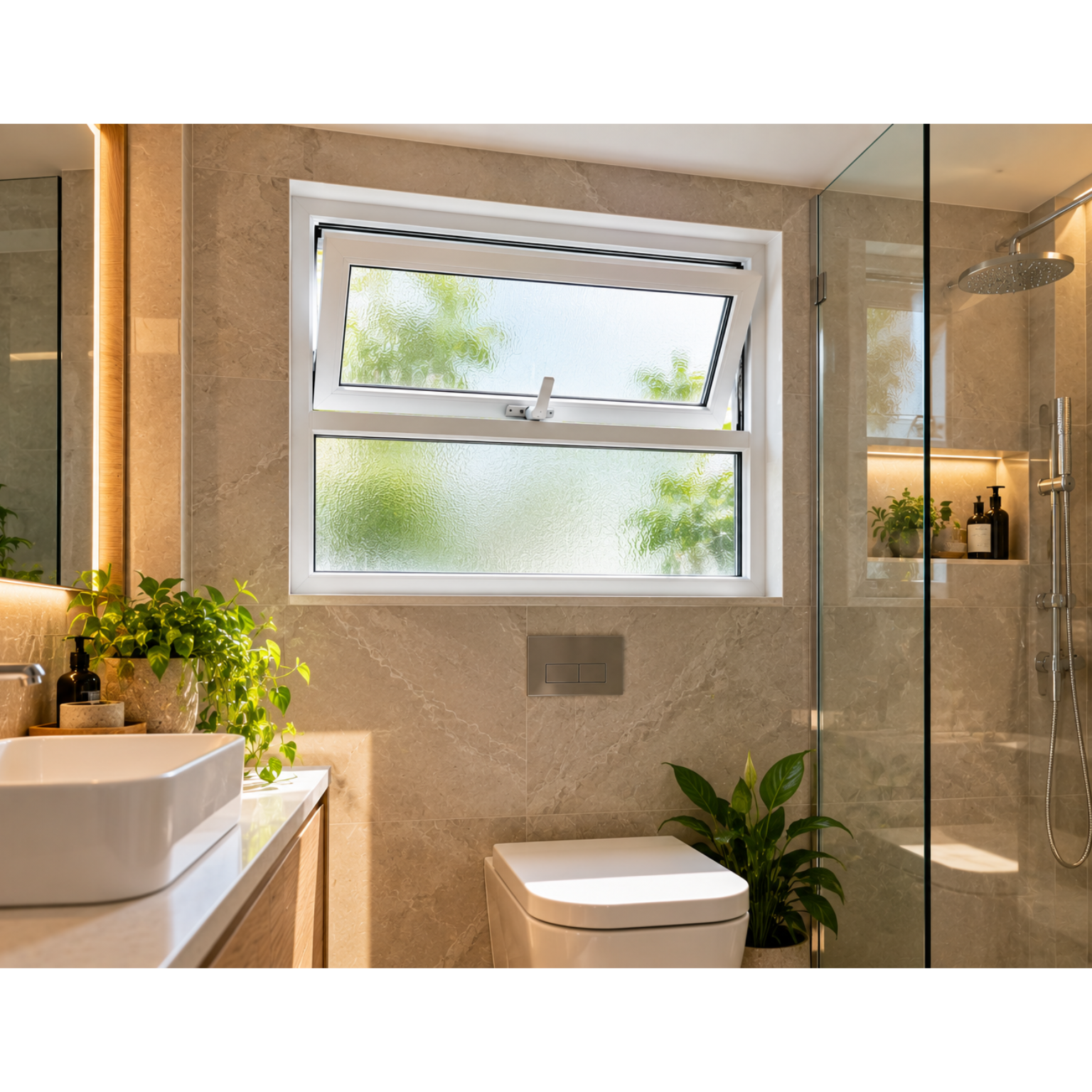
The uPVC frame offers a low-maintenance window solution, while frosted or obscured glass can allow daylight into the bathroom while limiting direct visibility.
For independent houses, villas, builder floors and apartments in Ghaziabad, bathroom-window requirements can vary considerably. A spacious villa bathroom facing a private garden has very different requirements from a compact builder-floor bathroom facing a neighbouring property.
The best solution therefore isn't simply:
“Install frosted glass.”
You need to consider the entire window:
Size + position + glass + opening style + ventilation + privacy + mesh + installation.
This guide explains how.
Why Is Frosted Glass Popular for Bathroom Windows?
A conventional clear-glass window allows light into the room but also permits direct visibility.
In a bathroom, that can create an obvious privacy problem.
Frosted glass changes the way light passes through the window.
Instead of providing a clear view through the pane, the surface diffuses visibility.
This allows the bathroom to receive natural daylight while providing significantly greater visual privacy than ordinary clear glass.
That combination makes frosted glass particularly suitable for:
Bathrooms
Powder rooms
Toilets
Dressing areas
Utility spaces
What Is Frosted Glass?
Frosted glass is glass treated or manufactured to create an obscured surface.
Instead of being completely transparent, it diffuses light and reduces clear visibility through the pane.
The exact appearance and privacy level can vary depending on the glass product.
You may encounter options such as:
Acid-etched glass
Sandblasted-style finishes
Patterned or textured privacy glass
Other obscured glazing products
The important thing is not simply whether the glass is described as “frosted.”
Ask:
How much privacy does this specific glass provide?
Why Pair Frosted Glass with uPVC?
The glass handles privacy.
The window frame handles operation, sealing and structural support.
uPVC can be a useful frame material for bathrooms because it generally requires relatively little routine maintenance.
Unlike painted timber, the frame does not rely on periodic repainting for everyday surface maintenance.
That can be useful in a room frequently exposed to moisture and condensation.
Benefit 1: Privacy Without Blocking All Natural Light
This is the biggest advantage.
A bathroom without a window can feel completely dependent on artificial lighting.
A clear window can create privacy concerns.
Frosted glass provides a middle ground.
Natural daylight can still enter while direct visibility is obscured.
This can make even a compact bathroom feel brighter during the day.
Benefit 2: Better Use of External Walls
Some homeowners avoid bathroom windows because the exterior faces another house.
That doesn't necessarily mean the wall should have no window.
A carefully positioned uPVC window with suitable privacy glass may still provide daylight and ventilation.
This is particularly relevant in Ghaziabad builder floors and independent houses where neighbouring properties may be relatively close.
Benefit 3: Low Routine Maintenance
Bathrooms regularly generate steam and condensation.
A uPVC frame is generally straightforward to wipe clean.
Routine maintenance may involve:
Cleaning the frame
Cleaning the glass
Inspecting gaskets
Keeping drainage paths clear
Checking handles and hardware
Best uPVC Bathroom Window Designs
The glass is only half the decision.
You also need to choose how the window opens.
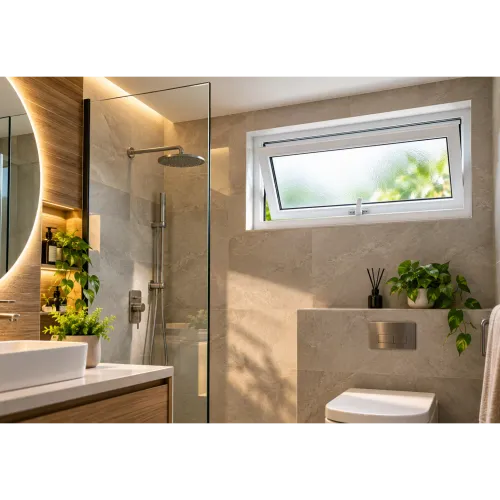
1. Top-Hung Frosted Window
A top-hung window is hinged near the top and opens outward from the bottom.
This is one of the most useful bathroom configurations because it can be installed relatively high on the wall.
Benefits include:
Privacy
Controlled ventilation
Compact design
Limited interior interference
It can work particularly well in smaller bathrooms.
2. Casement Window with Frosted Glass
A casement window opens on side hinges.
It can provide a relatively generous opening for ventilation.
This may be suitable for larger bathrooms in villas or independent houses where there is enough exterior clearance.
3. Tilt-Opening Frosted Window
A tilt configuration can provide controlled ventilation without requiring the sash to open fully.
This can be useful where regular airflow is desired while maintaining a more restricted opening.
4. Fixed Frosted Window
A fixed window does not open.
Why would you use one in a bathroom?
Because some bathrooms already have mechanical ventilation but need more natural light.
A fixed frosted window can provide privacy and daylight without adding an opening sash.
5. Fixed + Operable Combination
For larger bathrooms, this can be one of the most effective configurations.
For example:
Fixed Frosted Glass | Opening Frosted Window
The larger fixed section provides daylight.
The smaller operable section provides ventilation.
Frosted Glass vs Clear Glass
For most bathroom applications, frosted glass offers an obvious privacy advantage.
Clear Glass
Provides:
Maximum visual clarity
Strong daylight
Exterior views
But offers limited privacy without blinds or curtains.
Frosted Glass
Provides:
Diffused daylight
Increased privacy
Clean bathroom aesthetic
But does not provide a clear exterior view.
For a bathroom facing a private garden, clear glass combined with another privacy strategy may be possible.
For a bathroom facing a neighbouring property, frosted glass is often more practical.
Frosted Glass vs Tinted Glass
Tinting and frosting are not the same.
Tinted glass changes light transmission and appearance.
It should not automatically be assumed to provide the same privacy as obscured glass.
At night, when the bathroom is illuminated from inside, some glazing that appears private during the day can become much less private.
If privacy is the priority, select the glass specifically for privacy rather than assuming darker glass will solve the problem.
The Night-Time Privacy Test
This is one of the most important parts of choosing bathroom glass.
Imagine:
Outside: dark
Bathroom: bright LED lights
Now someone stands near the window.
Can their silhouette be seen?
The answer depends on the particular privacy glass.
Before finalising a product, understand how much obscurity it provides under different lighting conditions.
For highly exposed bathroom windows, additional privacy measures may still be appropriate.
How High Should a Bathroom Window Be?
Bathroom windows are commonly positioned relatively high.
This can provide several benefits:
Greater privacy
Reduced direct sightlines
More usable wall space below
Ventilation near the upper part of the room
However, don't place the window so high that it becomes difficult to operate or clean.
A good bathroom window should remain practical.
Bathroom Windows in Independent Ghaziabad Homes
Independent houses can provide more flexibility than apartments.
If the bathroom has a direct exterior wall, you can plan the window around:
Room dimensions
Exterior view
Neighbouring property
Shower position
Natural airflow
A larger frosted window may be possible where privacy glass protects visibility.
Bathroom Windows for Builder Floors
Builder floors often have tighter layouts.
The bathroom may face:
Rear setback
Adjacent building
Service shaft
Balcony
Here, high-level frosted windows can be particularly useful.
If natural airflow is limited, combine the window with an exhaust fan.
Frosted Windows for Villa Bathrooms
Larger villa bathrooms allow more creative glazing.
Instead of a tiny conventional ventilator, consider a larger privacy-glass composition.
For example:
Large fixed frosted panel + smaller opening sash
This can bring significantly more daylight into the bathroom while maintaining privacy.
Can Frosted Glass Be Used in the Shower Area?
Potentially, but the complete window position and installation should be designed appropriately.
Consider:
Direct water exposure
Hardware access
Cleaning
Window operation
Waterproofing around the opening
The frame-to-wall junction should be properly finished.
Does Frosted Glass Provide Ventilation?
No.
This distinction matters.
Glass provides privacy and daylight.
The opening mechanism provides ventilation.
A fixed frosted window will not provide direct natural airflow.
If ventilation is required, choose an operable window or provide suitable mechanical extraction.
Do You Still Need an Exhaust Fan?
Possibly.
A bathroom window and exhaust fan can complement each other.
A window provides natural ventilation when external airflow is available.
An exhaust fan mechanically removes humid air.
Bathrooms that:
Face narrow shafts
Have limited airflow
Are used frequently
Generate significant steam
may particularly benefit from mechanical extraction.
Can Frosted Bathroom Windows Help Prevent Dampness?
Ventilation can help manage indoor humidity.
But frosted glass itself does not prevent dampness.
Persistent dampness may be caused by:
Plumbing leaks
Waterproofing failure
Exterior seepage
Pipe condensation
Poor drainage
If moisture problems continue even with good ventilation, investigate the underlying cause.
Mosquito Mesh for Bathroom Windows
If the window remains open regularly, mosquito mesh can be useful.
The mesh arrangement depends on the window type.
It should be planned so that:
Airflow remains adequate
The window operates correctly
Cleaning remains possible
Ground-Floor Bathroom Security
For ground-floor bathrooms, privacy and security are separate considerations.
Frosted glass provides visual privacy.
It does not automatically make the opening secure.
Consider:
Window dimensions
Window height
Locking
Hardware
Appropriate glazing
Other security requirements
Single or Double Glazing?
For many small bathroom windows, single privacy glass may meet the basic requirement.
Double glazing may be considered where:
The bathroom faces a noisy road
Thermal performance matters
The window is relatively large
The rest of the home uses double glazing
A privacy finish or obscured pane can potentially be incorporated within an appropriate glazing specification.
What Determines the Price?
The price of a uPVC bathroom window with frosted glass depends on:
Window dimensions
uPVC profile
Opening style
Glass specification
Hardware
Mesh
Finish
Installation
Existing opening condition
Instead of comparing only a square-foot rate, compare the complete specification.
Common Mistakes to Avoid
Mistake 1: Assuming All Frosted Glass Is Equally Private
Different products provide different levels of obscurity.
Mistake 2: Forgetting Night-Time Privacy
Interior lighting changes how the glass appears from outside.
Mistake 3: Choosing a Fixed Window When Ventilation Is Needed
Fixed glass provides light, not airflow.
Mistake 4: Placing the Window Too High
Privacy is useful, but the window still needs to be operated and cleaned.
Mistake 5: Ignoring the Exhaust Fan
A small window may not provide sufficient ventilation in every bathroom.
Mistake 6: Treating Frosted Glass as Security Glass
Privacy and impact/security performance are different characteristics.
Why Choose JLM IMPEX for uPVC Bathroom Windows in Ghaziabad?
JLM IMPEX manufactures customised uPVC doors and windows for residential applications.
For bathrooms, the window can be planned according to opening dimensions, privacy requirements, glass preference, ventilation and exterior exposure.
This can be especially useful across Ghaziabad's independent houses, villas and builder floors, where bathroom layouts vary significantly.
The objective should be to create a window that provides the right balance of:
Privacy + daylight + ventilation + practical operation.
Final Thoughts
A bathroom window doesn't have to force you to choose between privacy and natural light.
The right uPVC bathroom window with frosted glass in Ghaziabad can provide both.
But the glass should be only one part of the decision.
Consider:
Frosted glass + opening style + window position + ventilation + exhaust + mesh + installation.
When these elements are planned together, even a relatively small bathroom window can make the space feel brighter, fresher and more comfortable.
Frequently Asked Questions
1. Is frosted glass good for bathroom windows?
Yes. It can provide natural daylight while reducing direct visibility through the window.
2. Is frosted glass completely private?
Privacy varies by glass product and lighting conditions, so the specific glass should be evaluated.
3. Can silhouettes be visible at night?
With some privacy glass, silhouettes may become more noticeable when the interior is brightly lit and the exterior is dark.
4. Which uPVC window design is best for a small bathroom?
Top-hung and other compact operable configurations can work well depending on the layout.
5. Can I use a casement window with frosted glass?
Yes, subject to the selected uPVC system and opening requirements.
6. Does frosted glass block natural light?
It diffuses light rather than eliminating it, although actual light transmission varies by glass.
7. Can I use a fixed frosted window?
Yes, particularly where daylight is required and ventilation is provided separately.
8. Do I still need an exhaust fan?
Possibly. It depends on bathroom size, usage and available natural airflow.
9. Can mosquito mesh be installed?
Suitable mesh options may be possible depending on the window configuration.
10. Is uPVC suitable for humid bathrooms?
uPVC's low-maintenance characteristics make it practical for many bathroom applications.
11. Can I use double glazing with frosted glass?
Appropriate double-glazing configurations with privacy requirements can be considered depending on the selected system.
12. Are frosted windows suitable for ground-floor bathrooms?
Yes, but privacy, security and accessibility should all be considered separately.
13. Can the window be installed inside the shower area?
Potentially, but waterproofing, hardware, cleaning and direct water exposure need careful planning.
14. What affects the price?
Size, profile, opening mechanism, glass, hardware, mesh, finish and installation are major factors.