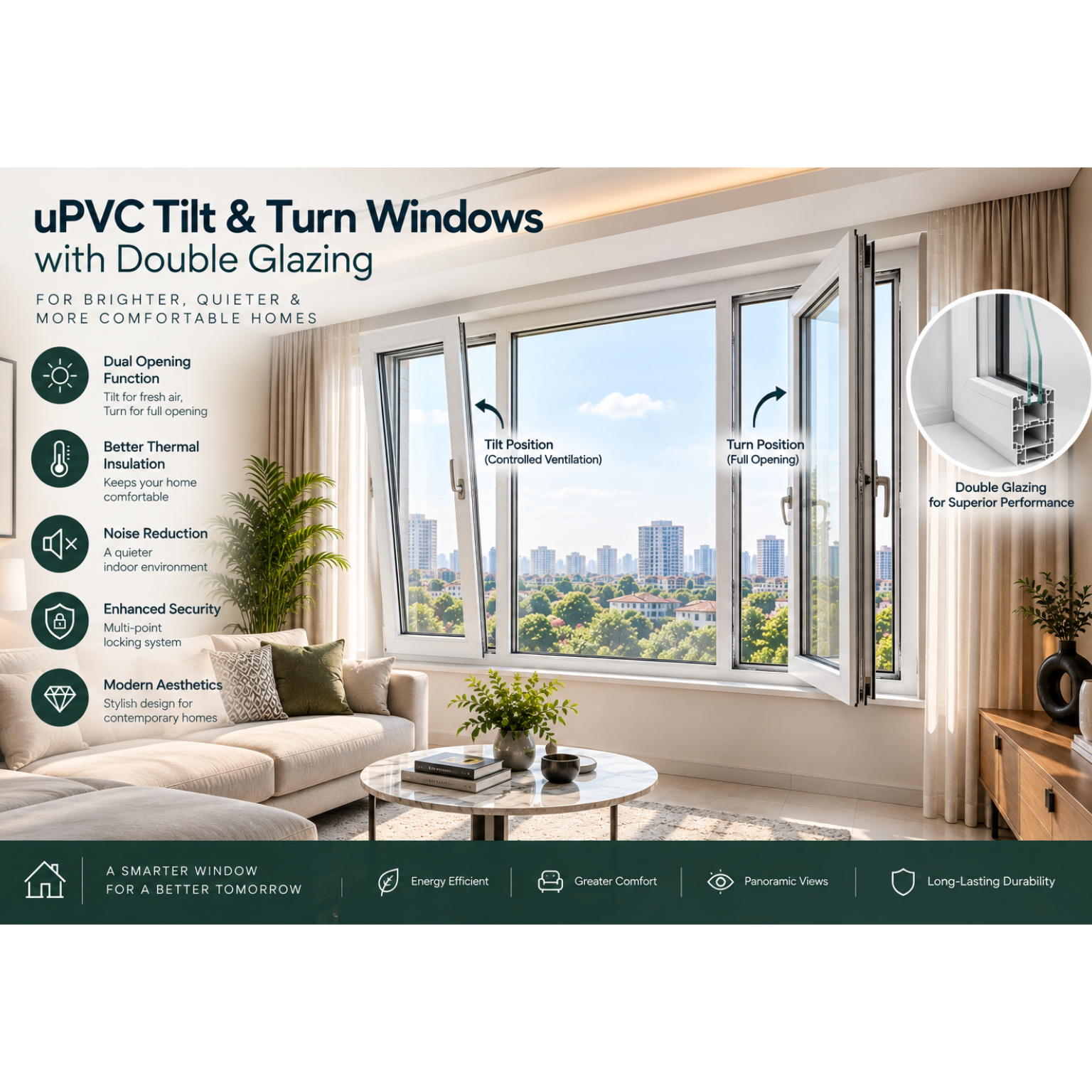
Choosing the right windows for a home is no longer simply about selecting a frame and a piece of glass. Modern homeowners increasingly expect their windows to provide ventilation, natural light, insulation, security, easy maintenance and an attractive appearance at the same time.
For homeowners looking for this combination, uPVC tilt & turn windows with double glazing in Ghaziabad are worth considering.
Tilt & turn windows are different from conventional sliding or casement windows because a single sash can operate in two ways. Turn the handle to one position and the upper part of the window tilts inward for controlled ventilation. Move it to another position and the entire sash opens inward.
When this mechanism is combined with double glazing, the window can also provide improved thermal and acoustic performance compared with a basic single-glazed window.
For Ghaziabad homes dealing with hot summers, winter temperature changes, dust, traffic activity and growing urban development, this combination can create a more comfortable and practical window system.
But how does it work, where should you use it and what should you consider before buying?
Let's understand.
What Is a uPVC Tilt & Turn Window?
A tilt & turn window is an inward-opening window with a specialised hardware system that enables two operating modes.
Tilt Mode
In tilt mode, the top of the sash moves inward slightly while the lower section remains connected to the frame.
This creates a smaller opening for controlled ventilation.
It can be particularly useful when you want fresh air without opening the entire window.
Turn Mode
In turn mode, the sash opens inward more fully, similar to an inward-opening casement window.
This provides:
- Wider ventilation
- Easier access to the window opening
- Convenient cleaning of the exterior glass
- Greater flexibility in everyday use
This dual functionality is one of the biggest reasons tilt & turn windows are increasingly considered for modern homes.
What Does Double Glazing Add?
Double glazing consists of two panes of glass separated by an insulating cavity.
The cavity helps slow down heat transfer through the glass and can also improve acoustic performance.
A complete tilt & turn window system therefore includes much more than the frame.
It should be considered as:
uPVC profile + reinforcement + double-glazed unit + gaskets + tilt & turn hardware + locking system + professional installation
The performance of the window depends on how well all these elements work together.
Why Consider Tilt & Turn Windows with Double Glazing in Ghaziabad?
Ghaziabad includes everything from independent houses and builder floors to villas and modern apartments.
Window requirements can therefore vary significantly from one property to another.
Here are some reasons homeowners may consider this configuration.
1. Controlled Everyday Ventilation
One of the most useful features of a tilt & turn window is the ability to ventilate a room without opening the sash completely.
In tilt mode, only the upper section opens inward.
This can work particularly well in:
- Bedrooms
- Study rooms
- Home offices
- Living rooms
- Guest rooms
During suitable weather, the tilt position can allow continuous controlled airflow while maintaining a relatively compact opening.
2. Improved Thermal Performance with Double Glazing
Ghaziabad experiences significant seasonal temperature variations.
During summer, rooms exposed to strong sunlight can heat up considerably.
During winter, heat can escape through poorly performing windows.
Double glazing introduces an insulating cavity between two panes of glass, which can help reduce heat transfer compared with conventional single glazing.
However, double glazing alone does not determine performance.
The result also depends on:
- Glass specification
- uPVC profile construction
- Gaskets
- Reinforcement
- Frame fabrication
- Sealing
- Installation
For strongly sun-exposed rooms, Low-E or solar-control glazing may also be considered depending on the project.
3. Better Noise Reduction
Traffic and neighbourhood noise can affect homes located near busy roads, markets, schools or commercial areas.
A properly designed double-glazed tilt & turn window can help reduce the amount of outside noise entering a room.
It is important, however, not to think of any window as automatically “soundproof.”
Acoustic performance depends on the complete specification, including:
- Glass thickness
- Glass composition
- Air gap
- Frame construction
- Gasket compression
- Installation quality
- Sealing around the window
For particularly noisy locations, laminated or specialised acoustic glass combinations may be worth discussing.
4. Convenient Cleaning
Cleaning the exterior side of conventional windows can sometimes be inconvenient, particularly on upper floors.
Tilt & turn windows solve part of this problem because the sash can open inward in turn mode.
This gives the homeowner access to both sides of the glass from inside the room.
For builder floors, duplex homes and upper-floor bedrooms in Ghaziabad, this can be a significant practical advantage.
5. Effective Sealing
Tilt & turn windows generally use perimeter hardware and gaskets around the sash.
When properly fabricated, adjusted and installed, this can provide effective sealing when the window is closed.
This is useful in a city where homeowners may want to limit:
- Dust infiltration
- Outdoor air leakage
- Heat transfer
- Noise penetration
No window should be described as completely dustproof in every real-world condition, but good fabrication and installation can significantly influence sealing performance.
Where Should You Use Tilt & Turn Windows?
Not every opening needs the same type of window.
Tilt & turn windows can be particularly suitable for certain rooms.
Bedrooms
Bedrooms are one of the strongest applications.
Tilt mode can provide controlled ventilation, while double glazing can help improve thermal and acoustic comfort.
Living Rooms
For medium-sized living-room openings, tilt & turn windows can create a clean contemporary appearance.
They can also be combined with fixed glass sections.
For example:
Fixed + Tilt & Turn + Fixed
This allows the fixed sections to provide more uninterrupted glass while the operable sash handles ventilation.
Study and Home Office
A tilt position can provide airflow without requiring the entire sash to remain open.
Double glazing can also be useful for workspaces exposed to traffic or neighbourhood activity.
Villas and Independent Houses
Ghaziabad has many independent homes and villas where window openings can be customised during construction or renovation.
This creates greater flexibility for using larger tilt & turn configurations or combinations with fixed windows.
Tilt & Turn vs Sliding Windows
Both designs have different strengths.
Sliding Windows
Sliding windows move horizontally along tracks.
They are particularly useful when:
- Space is limited
- Furniture is close to the window
- A simple operating mechanism is preferred
- Larger horizontal openings are involved
Tilt & Turn Windows
Tilt & turn windows require inward opening space but provide:
- Two opening modes
- Controlled ventilation
- Wider opening when required
- Easier cleaning
- Strong perimeter sealing potential
The correct choice depends on the room rather than assuming one design is always better.
Tilt & Turn vs Conventional Casement Windows
Casement windows typically open in one primary direction.
Tilt & turn windows add another ventilation mode.
If you regularly want smaller controlled ventilation openings, the tilt function can be valuable.
If you simply need a conventional fully opening window, a standard casement configuration may be sufficient.
The extra functionality of tilt & turn hardware also generally makes correct hardware selection and installation particularly important.
Choosing the Right Double Glazing
Not all double-glazed units are identical.
Clear Double Glazing
Suitable where natural light and visibility are priorities.
Toughened Double Glazing
Can be considered where safety and additional glass strength are required.
Laminated Glass Combination
Useful where additional safety or improved acoustic performance is desired.
Low-E Double Glazing
Low-emissivity glass can help manage heat transfer and may be useful for sun-exposed rooms.
Tinted or Solar-Control Glass
May be considered for windows receiving strong direct sunlight.
Your glass should be selected according to the room rather than using the same specification throughout the entire house.
Don't Ignore the Hardware
Tilt & turn windows depend heavily on their hardware system.
The same handle controls multiple locking and opening functions.
Therefore, buyers should ask about:
- Hardware brand/specification
- Multi-point locking
- Handle quality
- Maximum sash weight
- Hardware compatibility with window size
- Adjustment requirements
- After-sales support
A large, heavy double-glazed sash places greater demands on the hardware than a small single-glazed sash.
What About Security?
When properly configured, tilt & turn windows can incorporate multi-point locking systems.
In the closed position, locking points can engage at multiple locations around the sash.
For additional security requirements, homeowners can also discuss:
- Laminated glass
- Suitable locking hardware
- Reinforced profiles
- Secure handles
Security should always be evaluated as a complete system.
Are Tilt & Turn Windows Suitable for Ghaziabad Renovations?
Yes, but the existing opening should be inspected first.
Renovation projects may involve:
- Uneven walls
- Existing wooden or metal frames
- Old plaster
- Non-standard opening dimensions
- Sill problems
- Water seepage around old windows
Accurate site measurement is therefore important before manufacturing begins.
Simply replacing the old window without addressing the opening can compromise the new system.
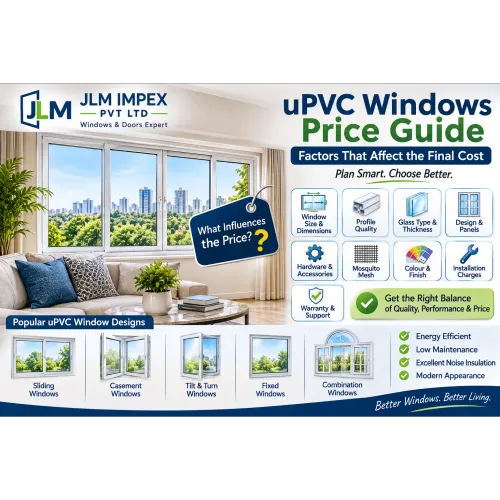
What Determines the Price?
There is no single price for a double-glazed tilt & turn window.
Cost depends on several variables:
Window Dimensions
Larger windows require more profile, glass and reinforcement.
Profile System
Different uPVC systems have different chamber designs, depths and reinforcement requirements.
Double-Glazed Specification
Clear, toughened, laminated, Low-E and specialised glass combinations have different costs.
Hardware
Tilt & turn mechanisms are more complex than basic window hardware.
Colour and Finish
White is often the basic option, while laminated wood finishes or specialised colours can affect pricing.
Installation
Installation complexity, floor level, access and opening condition can influence the final quotation.
For this reason, homeowners should compare specifications, not merely price per square foot.
What Should Be Included in Your Quotation?
Before approving a quotation, ask for clarity on:
| Component | What to Check |
|---|---|
| uPVC Profile | Brand/system and specification |
| Reinforcement | Type and placement |
| Glass | Exact double-glazed configuration |
| Hardware | Tilt & turn mechanism and locking |
| Gaskets | Sealing system |
| Dimensions | Final measured sizes |
| Finish | Colour/lamination |
| Installation | Included or separate |
| Sealing | Frame-to-wall finishing |
| Warranty | Applicable terms |
| After-sales | Adjustment/service support |
Why Choose JLM IMPEX for uPVC Tilt & Turn Windows in Ghaziabad?
JLM IMPEX manufactures customised uPVC window systems for residential and commercial requirements.
For tilt & turn windows, the company offers configurations that can incorporate double-glazed, toughened, laminated and Low-E glass along with multi-point locking and customised sizes.
More importantly, homeowners should evaluate the complete solution—from site measurement and window configuration to fabrication, glass, hardware and final installation.
For Ghaziabad homes, the appropriate specification can be selected according to room orientation, opening dimensions, noise exposure, ventilation requirements and budget.
Final Thoughts
uPVC tilt & turn windows with double glazing in Ghaziabad combine two useful ideas: flexible ventilation and improved glazing performance.
Tilt mode provides controlled ventilation. Turn mode provides a larger opening and easier cleaning. Double glazing can help improve thermal and acoustic performance.
But the best results depend on more than the window style.
Profile quality, reinforcement, glass specification, hardware, sealing and installation all matter.
Rather than asking only, “What is the price of a tilt & turn window?”, homeowners should ask:
What specification is right for this particular room and opening?
That approach is much more likely to deliver a window that performs well over time.
Frequently Asked Questions
1. What is a uPVC tilt & turn window?
It is a dual-function window that can tilt inward from the top for controlled ventilation or open further inward in turn mode.
2. Can tilt & turn windows have double glazing?
Yes. Tilt & turn uPVC systems can be configured with double-glazed units subject to the profile, hardware and design specification.
3. Are double-glazed tilt & turn windows good for Ghaziabad?
They can be useful for homes seeking improved insulation, controlled ventilation and noise reduction, particularly in bedrooms and living spaces.
4. Do tilt & turn windows reduce traffic noise?
A well-designed double-glazed system can help reduce outside noise. Performance depends on glass composition, sealing, profile construction and installation.
5. Are they completely soundproof?
No window should automatically be described as completely soundproof. Different acoustic specifications provide different levels of noise reduction.
6. Can tilt & turn windows help during summer?
Double glazing can help reduce heat transfer. Low-E or solar-control glass may also be considered for strongly sun-exposed rooms.
7. Are they easy to clean?
The inward-opening turn function can make accessing the exterior glass easier from inside the room.
8. Can I use tilt & turn windows in a bedroom?
Yes. Bedrooms are a popular application because the tilt function provides controlled ventilation.
9. Are tilt & turn windows suitable for villas?
Yes. They can work particularly well in modern villas and independent houses where openings can be customised.
10. Is a tilt & turn window more expensive than a basic window?
It can cost more than a basic configuration because the hardware mechanism is more sophisticated. Final cost depends on size, glass, profile, hardware and installation.
11. Can I get wood-finish uPVC tilt & turn windows?
Colour and laminated finish options may be available depending on the selected profile system.
12. What should I check before ordering?
Check profile specification, reinforcement, glass composition, hardware, locking system, dimensions, installation, sealing, warranty and after-sales support.