A good kitchen needs more than attractive cabinets, countertops and appliances.
It needs to breathe.
Cooking can generate heat, steam, moisture, odours and airborne grease. While a chimney or exhaust fan can help remove cooking fumes, natural ventilation can make the kitchen feel fresher and more comfortable during everyday use.
This is where uPVC ventilator windows for kitchens in Ghaziabad can play an important role.
From independent houses and villas to builder floors and apartments, kitchen layouts across Ghaziabad vary significantly. Some have large exterior-facing walls, while others have only a compact window opening near the cooking area or utility space.
The right kitchen ventilator therefore isn't simply the largest window you can install.
It should balance:
Ventilation + daylight + available space + ease of cleaning + insect protection + kitchen layout.
This guide explains how to choose the right configuration.
Why Does a Kitchen Need Good Ventilation?
Cooking changes the indoor environment quickly.
Depending on the cooking method, a kitchen can generate:
Heat
Steam
Food odours
Moisture
Smoke or cooking fumes
Airborne grease
If these remain trapped inside, the kitchen can feel stuffy and uncomfortable.
Moisture and grease can also accumulate on nearby surfaces over time.
A well-positioned ventilator window provides an additional route for natural air exchange.
However, natural ventilation and mechanical extraction should be considered complementary rather than competing solutions.
uPVC Window vs Chimney: Do You Need Both?
This is a common question.
A kitchen chimney is designed to capture cooking fumes close to the cooking area.
A window provides broader natural ventilation.
They perform different jobs.
A practical kitchen may therefore use:
Chimney + uPVC window
or
Exhaust fan + uPVC ventilator
depending on the layout.
A window should not automatically be treated as a replacement for a properly designed kitchen exhaust system.
Why Choose uPVC for Kitchen Windows?
Kitchen windows need to tolerate frequent exposure to moisture, cooking residue and everyday cleaning.
uPVC can be practical for several reasons.
1. Low Routine Maintenance
uPVC frames generally do not require routine painting or polishing.
2. Easy Cleaning
Kitchen windows can collect dust and cooking residue.
Smooth frame surfaces are relatively straightforward to wipe down.
3. Different Opening Configurations
Depending on the available opening, homeowners can consider casement, top-hung, sliding or other suitable configurations.
4. Custom Dimensions
Windows can be fabricated according to the actual kitchen opening rather than relying solely on standard sizes.
5. Glass Options
Clear, frosted, toughened and other suitable glass options can be selected according to the kitchen location and privacy requirement.
Best uPVC Ventilator Designs for Ghaziabad Kitchens
1. Casement Kitchen Window
A casement window can provide a relatively wide ventilation opening.
This makes it useful for kitchens with an exterior-facing wall.
When opened, it can allow substantial natural airflow.
For independent houses and villas where exterior clearance is available, casement windows can be an effective option.
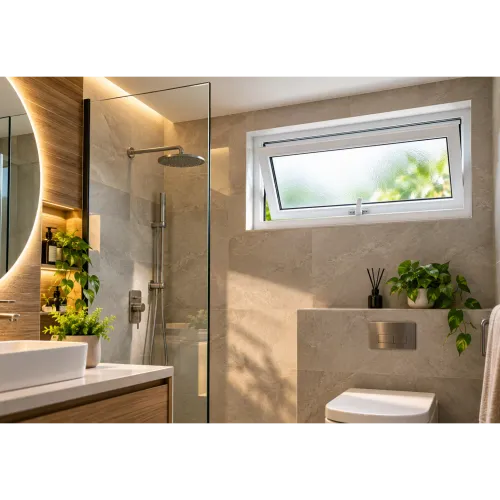
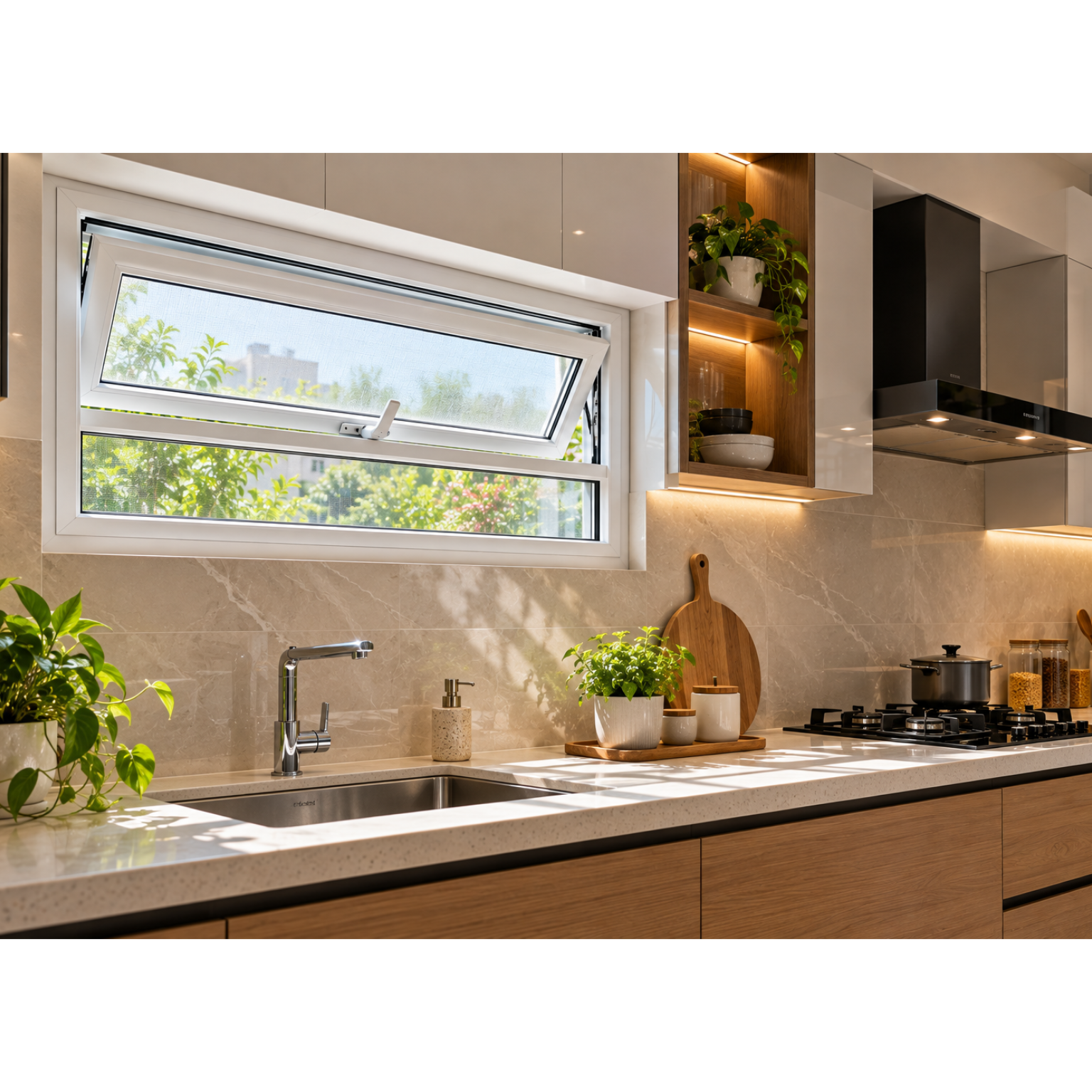
2. Top-Hung Kitchen Ventilator
A smaller top-hung window can work where wall space is limited.
Because it opens outward from the lower portion, it can provide ventilation without occupying significant interior space.
It may work particularly well above:
Countertops
Utility areas
Sinks
3. Sliding uPVC Kitchen Window
Sliding windows can be useful where outward or inward opening space is limited.
They are particularly practical behind countertops because the shutters remain within the window plane.
This can prevent interference with:
Taps
Utensils
Appliances
Countertop items
4. Fixed + Casement Kitchen Window
For larger kitchen openings, consider:
Fixed Glass + Casement
The fixed section brings additional daylight into the kitchen.
The opening section provides ventilation.
This can create a cleaner and more contemporary appearance.
5. Window with Exhaust Provision
Where an exhaust fan is required, the arrangement should ideally be planned before window fabrication.
Depending on the configuration, a suitable fixed section or dedicated provision may accommodate the exhaust.
Avoid randomly cutting a finished uPVC profile or glass unit later.
Where Should the Kitchen Window Be Located?
Window position can significantly affect how useful it is.
Above the Sink
This is a popular location because it provides natural light above the working area.
A sliding or appropriately configured opening window can work well here.
Near the Cooking Area
Ventilation close to cooking can be useful, but the window should not interfere with the chimney, hob or cabinetry.
Direct exposure to heat should also be considered.
Utility Area
A window between the kitchen and an exterior utility space can provide additional airflow.
Opposite Another Opening
Where possible, openings on different sides can support cross-ventilation.
This can help air move through the kitchen rather than simply entering and remaining trapped.
Cross-Ventilation in Independent Homes
Independent houses in Ghaziabad can have an advantage over apartments: greater flexibility in external wall openings.
Where the architecture allows, a kitchen window combined with another opening can support cross-ventilation.
For example:
Window → Kitchen → Utility Door
can create an airflow path.
The effectiveness depends on wind conditions and building layout, but thinking about airflow as a path is better than treating each window in isolation.
Kitchen Ventilators for Builder Floors
Builder-floor kitchens can have more limited exterior exposure.
The kitchen may face:
Balcony
Utility shaft
Rear setback
Service lane
In these situations, consider both natural and mechanical ventilation.
A compact uPVC window may provide useful daylight and airflow, while a chimney or exhaust fan handles cooking fumes.
Kitchen Windows for Villas
Villas often provide more design freedom.
Larger kitchen windows can combine fixed and operable sections to maximise natural light.
For example:
Casement | Fixed | Casement
can provide a broad glazed appearance while maintaining ventilation.
The exact configuration should be selected according to opening dimensions and kitchen cabinetry.
Clear or Frosted Glass?
Unlike bathrooms, kitchens don't always require privacy glass.
Clear Glass
Useful when:
The kitchen overlooks a garden
Maximum daylight is desired
Exterior views are attractive
Frosted Glass
Useful when:
Window faces a neighbouring property
Kitchen faces a service area
Privacy is preferred
The glass should match the location rather than following a universal rule.
Can a Kitchen Window Reduce Cooking Smells?
Opening a window can support air exchange and help cooking odours disperse.
However, it should not be expected to capture fumes as efficiently as a properly positioned kitchen chimney.
Strong cooking fumes are best addressed close to the source.
Think of the window as part of the overall ventilation strategy.
Mosquito Mesh for Kitchen Windows
For kitchens, mosquito and insect protection can be particularly important.
Food preparation areas can attract insects, and windows may remain open for extended periods.
Suitable mesh can help reduce insect entry while allowing airflow.
Plan mesh during the initial window design.
Kitchen Windows and Ghaziabad's Dust
A properly closed and sealed uPVC window can help limit air and dust infiltration through the opening.
When the window is open, however, outside air naturally enters.
Homes facing dusty roads or construction areas may therefore need to balance natural ventilation with external air conditions.
Is Double Glazing Necessary for Kitchens?
Not always.
For many kitchen ventilators, basic appropriate glazing may be sufficient.
Double glazing may be considered when:
Kitchen faces a noisy road
Opening is large
Thermal performance matters
The rest of the home uses double glazing
Choose according to the actual requirement.
Safety Near the Cooking Area
Avoid placing combustible items or unsuitable materials close to cooking heat.
The window layout should also avoid interfering with:
Gas burners
Chimney ducts
Electrical outlets
Overhead cabinets
Window design should be coordinated with the modular-kitchen plan before fabrication.
Cleaning Kitchen Windows
Kitchen windows can accumulate grease more quickly than bedroom windows.
Regular cleaning should therefore include:
uPVC frame
Glass
Handles
Tracks where applicable
Mesh
Drainage openings
Avoid allowing grease and dirt to build up around moving hardware.
Common Mistakes to Avoid
Choosing the Window After the Kitchen Cabinets
Coordinate the window before finalising cabinetry wherever possible.
Installing an Exhaust Fan Later
Plan exhaust provision beforehand.
Ignoring Mosquito Mesh
Kitchens often need insect protection more than other rooms.
Oversizing the Window
Cabinetry and counter space matter too.
Using Only a Tiny Fixed Window
A fixed window provides daylight but no direct natural ventilation.
Ignoring Cleaning Access
A kitchen window should be easy to reach and clean.
What Determines the Price?
The cost of a uPVC kitchen ventilator depends on:
Dimensions
Profile
Opening style
Glass
Hardware
Mesh
Exhaust provision
Finish
Installation
A larger combination window will naturally differ from a compact ventilator.
Kitchen Window Buying Checklist
Before ordering, check:
Exact opening dimensions
Counter height
Cabinet placement
Chimney position
Opening direction
Glass type
Mosquito mesh
Exhaust requirement
Exterior clearance
Hardware
Installation
Warranty
Why Choose JLM IMPEX for uPVC Kitchen Windows in Ghaziabad?
JLM IMPEX manufactures customised uPVC doors and windows for residential applications.
For kitchens, window configurations can be planned according to available wall space, cabinetry, ventilation, daylight and exterior exposure.
This customised approach can be particularly useful for Ghaziabad's independent houses, villas and builder floors, where kitchen sizes and layouts vary considerably.
Final Thoughts
A kitchen ventilator should never be selected as an afterthought.
The right uPVC ventilator window for a kitchen in Ghaziabad can bring in daylight, support natural airflow and make everyday cooking more comfortable.
But it works best as part of a complete system.
Think:
Window + chimney/exhaust + airflow + mesh + cabinetry + easy cleaning.
Design all of these together and even a relatively small kitchen window can make a meaningful difference.
Frequently Asked Questions
1. Which uPVC window is best for a kitchen?
Casement, sliding and top-hung configurations can all work depending on available space and ventilation requirements.
2. Is uPVC suitable for kitchen windows?
Yes. Its low-maintenance and easy-to-clean characteristics make it practical for many kitchens.
3. Do I need a window if I already have a chimney?
A window can still provide daylight and general natural ventilation. A chimney and window perform different functions.
4. Can an exhaust fan be fitted with a uPVC window?
Suitable arrangements may be possible when planned before fabrication.
5. Which window is best above a kitchen sink?
Sliding, casement or another suitable configuration can be used depending on tap position, exterior clearance and opening size.
6. Should I use mosquito mesh?
It can be particularly useful for kitchen windows that remain open frequently.
7. Can kitchen windows reduce cooking odours?
Natural ventilation can help disperse odours, while a chimney or exhaust system handles fumes closer to the cooking source.
8. Should kitchen glass be clear or frosted?
Choose according to view and privacy. Clear glass maximises visibility, while frosted glass can provide privacy.
9. Can I use double glazing?
Yes, where thermal or acoustic requirements justify it.
10. Are sliding windows good for kitchens?
Yes, particularly where counter space makes projecting shutters inconvenient.
11. Can a kitchen ventilator be customised?
Yes. Dimensions and configuration can be designed according to the available opening and selected system.
12. What should I check before ordering?
Check cabinetry, countertop height, opening direction, chimney, glass, mesh, exhaust provision and exterior clearance.