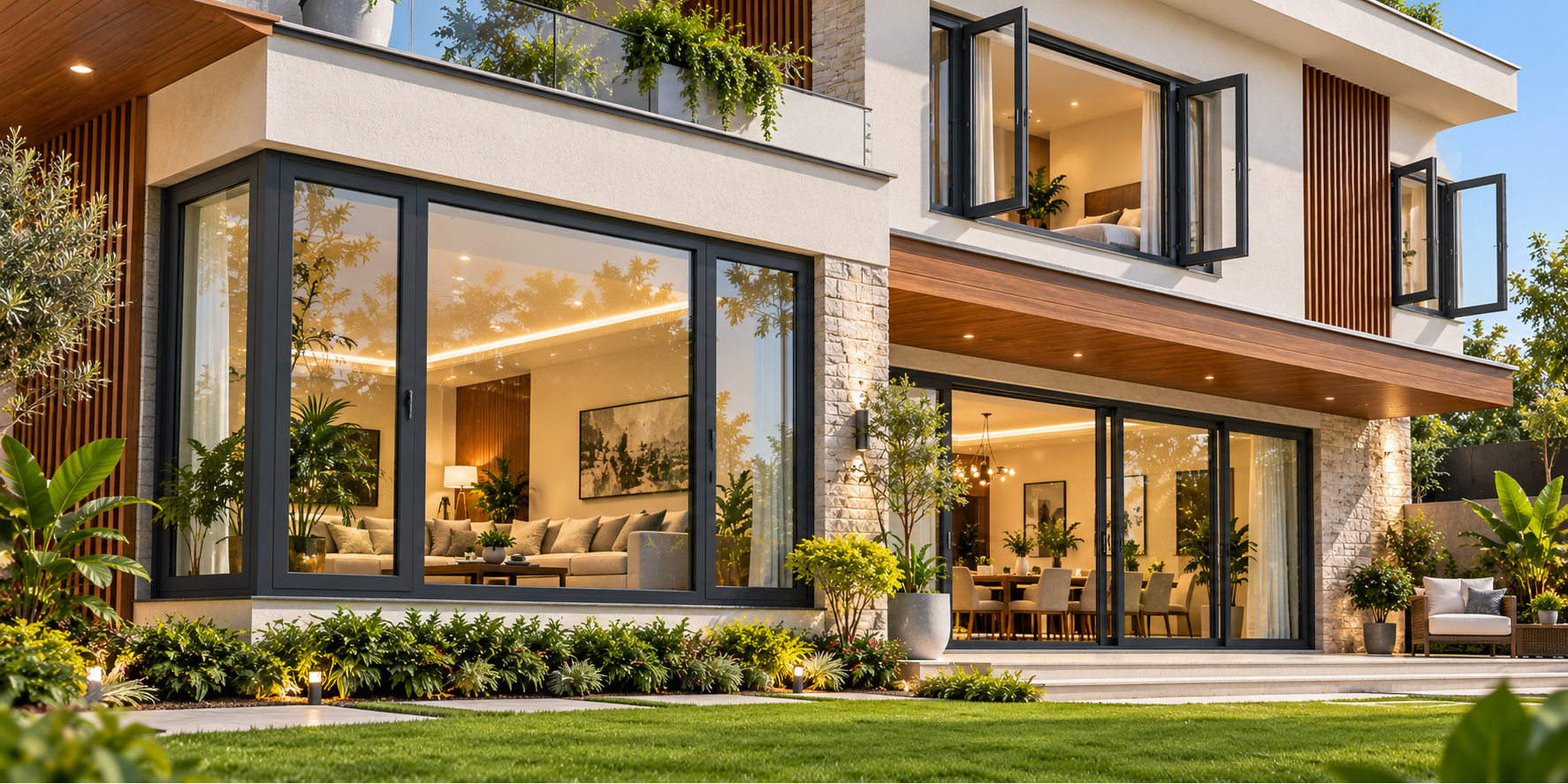
For years, many homeowners associated uPVC windows with one colour:
White.
White remains versatile, clean and suitable for many homes. But contemporary residential architecture increasingly uses warmer, darker and more coordinated exterior palettes.
Modern homes may combine:
Natural stone
Wood-finish cladding
Grey exterior paint
Textured walls
Metal railings
Glass balconies
Warm interior finishes
Against these materials, window colour becomes an important architectural decision.
This is where uPVC coloured windows in Ghaziabad can offer homeowners more design flexibility than conventional white frames alone.
Depending on the selected profile system, laminated or coloured finishes may allow uPVC windows to coordinate more closely with the façade and interiors.
But selecting a colour is not simply about choosing the darkest or trendiest option.
A good window colour should work with:
Architecture + façade material + room interiors + glass + natural light + long-term design.
This guide explains how to select coloured uPVC windows for modern homes, builder floors, villas and independent houses in Ghaziabad.
What Are Coloured uPVC Windows?
Coloured uPVC windows are uPVC window systems designed with an alternative surface colour or decorative finish instead of the conventional plain-white appearance.
Depending on the manufacturer and profile system, this may involve laminated finishes that create different visual effects.
Possible categories can include:
Wood-inspired finishes
Grey tones
Dark contemporary finishes
Neutral colours
Other profile-specific options
The exact finish availability should always be confirmed before designing the façade around a particular colour.
Why Are Coloured Windows Becoming Popular?
Modern residential architecture increasingly treats windows as part of the façade rather than simply functional openings.
A window frame creates visible lines around every glazed opening.
If a house has ten, fifteen or twenty windows, those frame lines significantly influence the building's appearance.
Coloured frames can help the windows coordinate with the architecture.
White vs Coloured uPVC Windows
Neither is automatically better.
White uPVC
Works particularly well with:
Light façades
Minimal interiors
Classic homes
Bright contemporary architecture
It can also make the frame feel visually lighter.
Coloured uPVC
Can work well with:
Stone façades
Wood accents
Grey architecture
Contemporary elevations
Earth-tone exterior palettes
The decision should be architectural rather than trend-driven.
Coloured Windows for Ghaziabad Independent Homes
Independent homes provide considerable design freedom.
Unlike some apartment buildings where the exterior façade may need to remain uniform, independent homeowners can coordinate the window finish with the entire elevation.
For example:
Warm stone façade + wood-inspired window finish
can create a warmer residential appearance.
Alternatively:
White/grey façade + darker window frame
can create stronger visual contrast.
Coloured uPVC for Builder Floors
Builder floors often use contemporary façade materials such as:
Stone
Exterior tiles
Wood-look cladding
Glass railings
Metal elements
A carefully chosen uPVC frame finish can make the window feel integrated with these materials.
However, avoid selecting each element independently.
Choose the window colour alongside the elevation palette.
The 60-30-10 Approach to Exterior Colour
A simple way to think about façade colours is:
60% — Main Building Colour
Usually the dominant wall or stone colour.
30% — Secondary Material
Wood cladding, stone, texture or another surface.
10% — Accent
Window frames, railings or selected architectural details.
This isn't a strict architectural rule, but it can help prevent a façade from becoming visually chaotic.
Wood-Finish uPVC Windows
Wood-inspired finishes can work particularly well where homeowners want the warmth of timber aesthetics with the practical characteristics of a uPVC window system.
They may complement:
Beige stone
Brick
Cream façades
Wooden entrance doors
Warm interior furniture
But avoid trying to match every wood element perfectly.
Slightly complementary tones can often look more natural than several near-matching but visibly different “wood” colours.
Grey uPVC Windows
Grey works particularly well with contemporary architecture.
It can coordinate with:
Concrete-inspired finishes
White walls
Charcoal railings
Glass balconies
Modern exterior tiles
Darker frames also create stronger outlines around the glass.
This can make the windows more visually prominent.
Dark-Coloured Frames
Dark frames can produce a sophisticated modern look.
They can work particularly well with large glass areas.
However, consider the overall elevation.
If every architectural element is dark, the façade can become visually heavy.
Balance dark windows with lighter wall surfaces or natural materials.
Should All Windows Be the Same Colour?
From the exterior, consistency is generally desirable.
Using different exterior frame colours on different rooms can make a façade look unplanned.
Unless the architecture intentionally calls for variation, maintain one primary exterior window finish.
What About the Interior Side?
The interior window colour should also coordinate with:
Wall colour
Flooring
Furniture
Curtains
Doors
Wardrobes
If the selected system offers different finish possibilities, ask what is available rather than assuming exterior and interior surfaces can be independently customised.
Coloured Sliding Windows
Sliding windows can look particularly clean in modern architecture.
They work well for:
Living rooms
Bedrooms
Balconies
Wide openings
A darker or wood-inspired frame can visually emphasise horizontal lines.
Coloured Casement Windows
Casement windows can work well in bedrooms and living spaces where greater ventilation is desired.
When using a darker finish, pay attention to the number of frame divisions.
Too many narrow shutters can create excessive dark lines across the façade.
Coloured Fixed Windows
Fixed windows are excellent for showcasing coloured frames because the configuration can remain visually simple.
They work well in:
Staircases
Living rooms
Entrance foyers
Feature walls
A large fixed glass panel with a coordinated coloured frame can create a strong architectural feature.
Coloured French Windows
French windows can combine contemporary finishes with more elegant residential proportions.
They may suit:
Bedrooms
Formal living rooms
Garden-facing rooms
Balconies
Wood-inspired finishes can work particularly well where a warmer aesthetic is desired.
Tilt-and-Turn Windows
Tilt-and-turn windows can also be incorporated into modern architectural designs.
Their appearance is influenced by:
Frame finish
Glass
Handle
Surrounding wall colour
Keep hardware visually coordinated with the frame where suitable options are available.
Colour and Glass Need to Work Together
Window appearance isn't determined by the frame alone.
Glass also affects how the window looks.
Clear glass reflects the exterior differently according to daylight.
Solar-control or other coated glass may have a different visual appearance.
Therefore, review the frame and glass combination together.
Matching Windows With Stone Façades
Stone and coloured uPVC can work beautifully together.
Beige Stone
Consider warm neutrals or wood-inspired finishes.
Grey Stone
Grey or darker contemporary finishes can create a cohesive palette.
Mixed Stone
Keep the window colour relatively restrained so the façade doesn't become overly busy.
Matching Windows With Brick
Brick already contains strong colour and texture.
A neutral or darker frame can provide contrast without competing with the brickwork.
Wood-inspired finishes may also suit certain brick palettes.
Matching Windows With White Walls
White façades provide maximum flexibility.
White frames create a seamless appearance.
Grey or dark frames create contrast.
Wood-inspired finishes add warmth.
The choice depends on whether you want the window to blend in or stand out.
Matching Windows With Wooden Doors
Don't assume the window must exactly match the main entrance door.
Different materials rarely reproduce identical colours.
Instead, aim for a coordinated palette.
For example:
Warm walnut-style door + complementary wood-tone window
can work better than trying to create an imperfect exact match.
Window Colour and Room Size
Dark frames create stronger visual boundaries.
In very small rooms, lighter frames may feel visually softer.
In large rooms with broad glazing, darker frames can create an intentional architectural outline.
Colour and Natural Light
Remember that a colour sample can look different:
Indoors
Outdoors
In direct sunlight
Under warm artificial light
Against different wall colours
Always evaluate physical samples in the actual project environment when possible.
Don't Select Colours From a Phone Screen
Digital colours are unreliable for final material selection.
Screen brightness, photography and editing can alter appearance.
Ask to see an actual profile or laminate sample.
Are Coloured uPVC Windows Only About Appearance?
No.
Colour is primarily an aesthetic choice, but the window must still perform its functional role.
Evaluate:
Profile system
Reinforcement
Glass
Hardware
Gaskets
Drainage
Fabrication
Installation
A beautiful colour cannot compensate for an unsuitable window specification.
Glass Options
Coloured uPVC windows can be paired with different glazing specifications depending on the system.
These may include:
Clear glass
Toughened glass
Laminated glass
Privacy glass
Double glazing
Performance glazing
Select glass according to the room rather than frame colour.
Mosquito Mesh
Mesh can be incorporated into compatible window systems.
When choosing a coloured frame, also consider the visual appearance of the mesh frame.
A poorly coordinated mesh can interrupt an otherwise clean design.
Hardware
Handles, locks and hinges can influence the finished appearance.
Ask what hardware finishes are available with the selected window system.
You don't necessarily need every piece of hardware to disappear, but it should not look accidental.
Coloured Windows for Renovation
Replacing old windows can significantly change the exterior appearance of an independent house.
Before choosing a darker frame, create a simple elevation mock-up.
This can help you see whether the new frames:
Improve the architecture
Make openings look smaller
Clash with existing stone
Work with railings and gates
Do Dark Windows Make Openings Look Smaller?
They can create stronger visual outlines.
Whether that makes an opening feel smaller depends on:
Frame width
Wall colour
Glass area
Window proportions
This is why configuration matters as much as colour.
Common Colour Selection Mistakes
1. Following Trends Blindly
Today's fashionable colour should still work with the house several years later.
2. Matching Too Many Materials
Window, door, cladding and furniture do not all need to be identical.
3. Selecting From Digital Images
Use physical samples.
4. Ignoring the Interior
The window is visible from both sides.
5. Too Many Frame Divisions
Dark colours can make unnecessary mullions even more noticeable.
6. Selecting Colour Before Configuration
First decide the correct window design. Then refine its appearance.
How to Compare Coloured uPVC Window Quotations
Ask each supplier to specify:
Profile system
Exact finish
Configuration
Reinforcement
Glass
Hardware
Mesh
Installation
Warranty
Make sure the quoted finish is clearly documented.
Why Choose JLM IMPEX for Coloured uPVC Windows in Ghaziabad?
JLM IMPEX manufactures customised uPVC windows and doors for residential projects.
For Ghaziabad homes, window configurations can be planned according to the architecture, opening dimensions, glass, ventilation requirements and available profile finishes.
This is particularly useful for independent houses and builder floors where homeowners have greater freedom to coordinate the window appearance with the exterior elevation.
Final Thoughts
The best uPVC coloured windows in Ghaziabad aren't necessarily the darkest or most fashionable.
They are the ones that make the entire house look more coherent.
Before choosing a finish, put these materials together:
Wall colour + stone + wood + railing + glass + window frame.
Then ask:
Does the window need to blend in?
Or should it become an architectural accent?
Once you answer that question, colour selection becomes much easier.
Frequently Asked Questions
1. Are uPVC windows available in colours other than white?
Depending on the selected profile system, coloured or laminated finish options may be available.
2. Are wood-finish uPVC windows real wood?
No. The underlying window system is uPVC; wood-inspired finishes are designed to create a different visual appearance.
3. Which colour is best for a modern house?
It depends on the façade. White, grey, darker tones and wood-inspired finishes can all work in the right architectural palette.
4. Do coloured uPVC windows suit builder floors?
Yes. They can coordinate well with stone, exterior tiles, glass railings and contemporary façades.
5. Should all windows have the same exterior colour?
Usually, maintaining a consistent exterior finish creates a more coherent façade.
6. Can coloured windows be used with double glazing?
Depending on the window system, coloured frames can be combined with different glazing specifications, including compatible double-glazed configurations.
7. Which frame colour works with beige stone?
Warm neutral or wood-inspired finishes can complement beige stone, though physical samples should be compared.
8. Which colour works with a grey façade?
White can create contrast, while grey or darker finishes can produce a more integrated contemporary look.
9. Can I use coloured uPVC sliding windows?
Yes, subject to the available finish options in the selected sliding system.
10. Are coloured frames suitable for fixed windows?
Yes. Fixed glazing can look particularly clean with a carefully coordinated frame finish.
11. Should my window match my main door exactly?
Not necessarily. Coordinated colours often work better than attempting an imperfect exact match across different materials.
12. Can I choose colour from an online image?
Use online images for inspiration, but final selection should preferably be based on physical samples.
13. Does the glass affect how the frame colour looks?
Yes. Glass reflections and coatings can influence the overall visual appearance.
14. What should I compare before ordering?
Compare profile, finish, configuration, reinforcement, glass, hardware, installation and warranty.