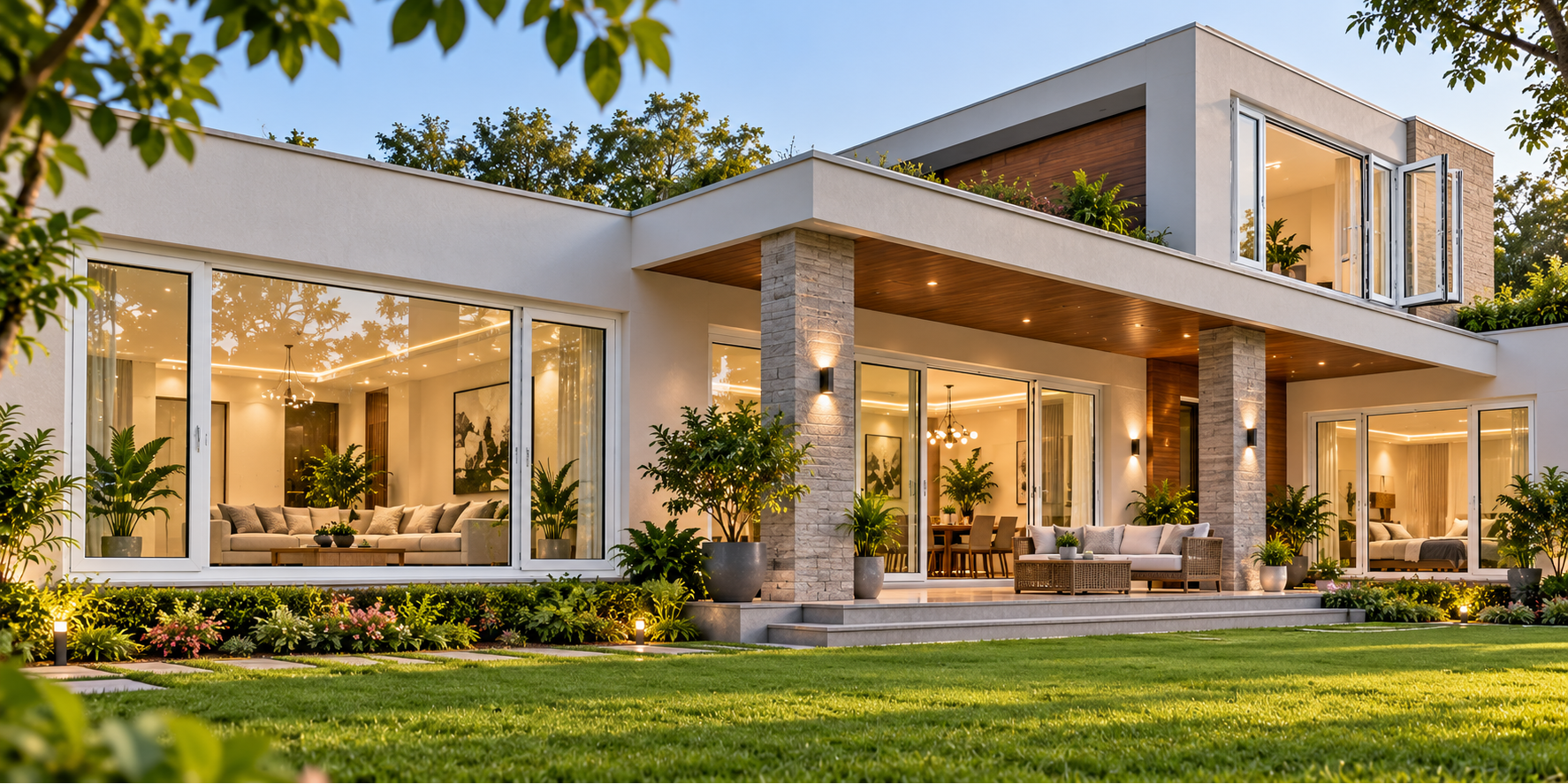
Choosing windows for a farmhouse or a large independent home is very different from choosing windows for a standard apartment.
A farmhouse may have a large lawn-facing living room, bedrooms on multiple sides, wide verandas, a dining room opening toward the garden, tall staircase walls, utility spaces and several exterior elevations.
That means one standard window design is unlikely to work throughout the property.
The right uPVC windows for farmhouses in Ghaziabad should be planned as part of the architecture of the entire home.
A garden-facing living room may benefit from large fixed glazing combined with operable sections. A bedroom may need casement windows and mosquito mesh. A kitchen may need a practical sliding window. Bathrooms need privacy. Staircases may need tall fixed windows.
The right approach is therefore:
Property planning → room function → orientation → window configuration → glass → hardware → installation.
This guide explains how to plan uPVC windows for farmhouses and larger homes without unnecessarily repeating one window design everywhere.
Why Farmhouse Windows Need More Planning
Large properties usually have more external wall area than apartments.
That means windows influence:
Exterior architecture
Natural daylight
Cross ventilation
Garden views
Indoor temperature
Privacy
Security
Maintenance
Indoor-outdoor connection
A poor window decision repeated across 20 or 30 openings becomes a much bigger problem than one poorly selected apartment window.
Create a complete window strategy before fabrication begins.
Why Consider uPVC for Large Homes?
uPVC can be a practical option for residential projects because it supports several window configurations and generally requires relatively low routine maintenance.
Depending on the selected system, options can include:
Sliding windows
Casement windows
Fixed windows
French windows
Tilt-and-turn windows
Top-hung windows
Combination windows
JLM IMPEX currently offers these types of customised uPVC systems for residential applications.
However, don't judge a farmhouse window only by the frame material.
Performance depends on the complete combination of:
Profile + reinforcement + glass + hardware + gaskets + fabrication + installation.
Start With a Farmhouse Window Master Plan
Before selecting individual windows, divide the property into zones.
Zone 1: Garden-Facing Areas
Priority:
Views
Daylight
Indoor-outdoor connection
Zone 2: Bedrooms
Priority:
Ventilation
Privacy
Mosquito protection
Comfort
Zone 3: Road or Entrance Side
Priority:
Privacy
Security
Noise management
Zone 4: Service Areas
Priority:
Practical ventilation
Privacy
Easy cleaning
This immediately prevents the mistake of specifying every window identically.
Large Living-Room Windows
The living room is often the most visually important space in a farmhouse.
If it faces a lawn or landscaped garden, the window should frame that view rather than unnecessarily divide it.
Instead of:
Casement | Casement | Casement | Casement
consider a configuration such as:
Fixed | Casement | Fixed
The larger fixed sections preserve views and daylight.
The opening section provides ventilation.
For wider horizontal openings, another possibility is:
Fixed | Sliding | Sliding | Fixed
The final configuration should be designed around the actual dimensions and selected window system.
Why Fixed Windows Work Well in Farmhouses
Farmhouses often have attractive external views.
Fixed windows can make excellent use of them.
They can work particularly well for:
Living rooms
Dining areas
Staircases
Entrance foyers
Double-height spaces
Garden-facing walls
Because fixed windows do not open, they should be combined with operable sections where ventilation is required.
Casement Windows for Bedrooms
Casement windows can be highly suitable for farmhouse bedrooms.
They can provide a relatively large ventilation opening and, with an appropriate system, good perimeter sealing when closed.
For a large bedroom, consider:
Fixed + Casement
rather than making every section operable.
This can increase the glazed area while keeping ventilation practical.
Tilt-and-Turn Windows for Premium Bedrooms
Tilt-and-turn windows can offer flexible ventilation.
The tilt position provides a smaller opening for controlled airflow.
The turn position opens the sash more widely.
They can work well for:
Master bedrooms
Guest suites
Home offices
Premium lounges
However, because they open inward in turn mode, furniture and curtain placement should be planned accordingly.
Sliding Windows for Wide Rooms
Sliding windows are useful where you want operable glazing without swing clearance.
They can work well in:
Family lounges
Bedrooms
Dining rooms
Balcony areas
Entertainment spaces
For larger openings, shutter dimensions and glass weight become important.
Do not simply make individual sliding shutters as large as possible.
French Windows for Farmhouse Architecture
French windows can create a more elegant architectural character.
They can work particularly well in:
Garden-facing bedrooms
Formal lounges
Dining rooms
Verandas
Courtyard-facing rooms
Their wider opening can strengthen the connection between the interior and garden.
Farmhouse Windows and Garden Views
A major advantage of a farmhouse is often the surrounding landscape.
Design the windows to make use of it.
Before deciding where fixed glass should go, stand inside the unfinished room and identify:
Main garden view
Trees
Lawn
Pool
Courtyard
Entrance landscape
Position large uninterrupted glass areas toward the strongest view.
This is more effective than designing the window only from the exterior elevation.
Windows for a Farmhouse Dining Room
A dining room overlooking a lawn can use broad glazing to create a brighter space.
Possible configurations include:
Fixed + casement
Fixed + French
Sliding
Combination glazing
If the dining room connects directly to a patio, coordinate windows with the patio door so the façade feels consistent.
Kitchen Windows
Farmhouse kitchens are often larger than apartment kitchens.
They may also face:
Kitchen garden
Utility courtyard
Side lawn
Backyard
Possible window types include:
Sliding
Casement
Fixed + casement
Top-hung
Coordinate the window with the sink, faucet, cabinets, hob and chimney.
Bathroom Windows
Large homes often contain multiple bathrooms.
Instead of treating each one as an afterthought, establish a consistent privacy-window strategy.
Consider:
Frosted/privacy glass
Top-hung windows
Small casement windows
Tilt openings
Exhaust ventilation
The goal is daylight and ventilation without compromising privacy.
Staircase Windows
A large home can have deep internal circulation areas.
Tall staircase glazing can introduce natural daylight into these spaces.
Fixed windows are particularly useful here.
However, ask one important question:
How will the exterior glass be cleaned?
Avoid creating inaccessible glazing simply because it looks impressive in the elevation drawing.
Double-Height Windows
Double-height living areas are increasingly common in larger homes.
These can use a combination such as:
Fixed upper glazing + accessible operable lower glazing
The upper glass provides daylight and architectural impact.
The lower section provides ventilation.
This is often more practical than trying to make high-level windows regularly operable.
Natural Cross Ventilation
Farmhouses often have one major advantage over dense urban properties: multiple exterior elevations.
Use them.
If a room has openings on opposite or adjacent sides, natural airflow can potentially move across the space more effectively.
Plan operable windows according to:
Prevailing airflow
Room layout
Furniture
Privacy
Exterior landscaping
Don't make every strategically useful opening fixed simply for appearance.
Glass Selection for Farmhouses
Large homes may require several different glass specifications.
Clear Glass
Useful for garden-facing windows where views are important.
Toughened Glass
May be considered according to panel size, safety requirements and application.
Laminated Glass
Can provide additional safety characteristics and may contribute to an acoustic strategy.
Double Glazing
Can improve thermal and acoustic insulation compared with basic single glazing when correctly specified.
Low-E Glass
May be considered where improved thermal performance is required.
Solar-Control Glass
Can be useful for strongly sun-exposed elevations depending on project requirements.
Frosted Glass
Suitable for bathrooms and other privacy-sensitive areas.
Don't Use the Same Glass Everywhere
This is particularly important in a large property.
A shaded north-facing bedroom may not require the same glass as a large west-facing living room.
Similarly, a quiet lawn-facing room may have different acoustic requirements from a room near the entrance road.
Create a glass schedule by elevation.
Ghaziabad Summers and Large Glass Areas
Large windows can bring beautiful daylight into a farmhouse.
But strongly sun-exposed glazing can also influence indoor heat gain.
For large west-facing openings, evaluate:
Exterior shading
Roof overhangs
Pergolas
Trees
Curtains
Glass specification
Good architecture and good glazing should work together.
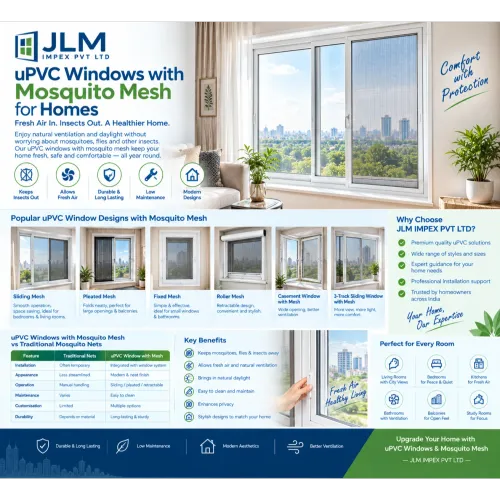
Farmhouse Windows and Mosquito Protection
Properties surrounded by lawns and landscaping may experience more insects than dense urban apartments.
Mosquito mesh can therefore be particularly valuable.
Consider mesh for:
Bedrooms
Kitchen
Family lounge
Study
Frequently opened windows
Plan it during window design.
Don't wait until after installation.
Ground-Floor Security
Most farmhouse windows are relatively accessible from ground level.
Security should therefore be considered throughout the project.
Review:
Locking hardware
Glass
Opening sizes
Accessible handles
Additional security measures where required
Mosquito mesh is not a security barrier.
Privacy Around Large Plots
A farmhouse may offer more privacy than an urban home, but the front and service sides can still require careful planning.
Instead of using privacy glass everywhere, identify actual sightlines.
You can use:
Landscaping
Boundary walls
Curtains
Strategic window placement
Frosted glass where necessary
This preserves clear garden views where privacy isn't a concern.
Weather and Drainage
Large homes can have windows exposed to different weather directions.
Check:
Window drainage
Exterior sill
Perimeter sealing
Roof overhang
Rain exposure
A sheltered veranda window and an exposed first-floor window may behave differently during heavy rain.
Frame Colour
Frame colour should be coordinated with the entire farmhouse exterior.
White uPVC works with many residential styles.
Other available finishes may suit projects using:
Stone
Brick
Wood tones
Contemporary grey façades
Always review physical samples alongside the exterior materials.
Create a Window Schedule
For a large property, don't manage the project through verbal descriptions.
Prepare a window schedule.
| ID | Room | Configuration | Glass | Mesh | Priority |
|---|---|---|---|---|---|
| W01 | Living | Fixed + Casement | Selected glazing | No | Garden view |
| W02 | Master Bed | Casement | Selected glazing | Yes | Ventilation |
| W03 | Kitchen | Sliding | Clear | Yes | Practicality |
| W04 | Bathroom | Top-hung | Frosted | Optional | Privacy |
| W05 | Staircase | Fixed | Clear | No | Daylight |
Repeat this for every opening.
What Determines Farmhouse Window Cost?
Pricing depends on:
Total window area
Number of openings
Profile system
Configuration
Glass
Reinforcement
Hardware
Mosquito mesh
Finish
Installation complexity
For a large home, comparing only one ₹/sq. ft. number can hide important differences.
Request a detailed window-by-window specification.
Common Farmhouse Window Mistakes
Using One Window Type Everywhere
Convenient for ordering, poor for functionality.
Making Every Large Panel Operable
This can create unnecessarily heavy shutters.
Too Many Vertical Divisions
This can interrupt garden views.
Ignoring Orientation
Different elevations experience different sunlight.
Forgetting Mosquito Mesh
Especially important around landscaped properties.
Ignoring Security
Ground-floor accessibility changes the security requirement.
No Cleaning Strategy
Tall fixed windows need maintenance access.
Choosing Glass at the End
Glass should be part of the initial design.
Why Choose JLM IMPEX for uPVC Farmhouse Windows in Ghaziabad?
JLM IMPEX manufactures and supplies customised uPVC windows and doors for residential projects across Ghaziabad and Delhi NCR.
Its current uPVC range includes sliding, casement, fixed, French, tilt-and-turn and top-hung configurations, with customisation based on project dimensions, glass and hardware requirements.
For farmhouses and large independent homes, this flexibility allows different rooms to use different configurations instead of forcing one window type throughout the property.
Final Thoughts
The best uPVC windows for farmhouses in Ghaziabad should make the most of the property's biggest advantages:
Space. Views. Daylight. Ventilation. Landscaping.
Start with the architecture rather than the product catalogue.
Identify which windows should frame views.
Identify which need to open.
Identify where privacy matters.
Identify where mosquito protection is required.
Identify which elevations receive strong sunlight.
Then build a room-by-room window schedule.
That approach produces a more functional and visually coherent large home.
Frequently Asked Questions
1. Are uPVC windows suitable for farmhouses?
Yes. Different uPVC configurations can be selected according to room function, opening size, views and ventilation requirements.
2. Which windows are best for farmhouse living rooms?
Large fixed sections combined with casement or sliding sections can balance garden views and ventilation.
3. Can uPVC windows be used for large openings?
Yes, subject to the selected system, dimensions, reinforcement, glass and hardware.
4. Which windows are best for farmhouse bedrooms?
Casement and tilt-and-turn configurations can provide useful ventilation, while sliding windows may suit rooms where swing clearance is limited.
5. Should farmhouse windows have mosquito mesh?
Mesh can be particularly useful on frequently opened windows near gardens and landscaping.
6. Is double glazing suitable for a farmhouse?
It can be considered where improved thermal or acoustic performance is required.
7. Which glass should be used for garden-facing windows?
Clear glazing is often desirable for views, subject to safety, solar and other project requirements.
8. What should I use for bathrooms?
Privacy glazing combined with top-hung or other suitable operable configurations can work well.
9. Can I use French windows in a farmhouse?
Yes. They can work particularly well in garden-facing bedrooms, lounges and dining areas.
10. How should I plan staircase windows?
Prioritise daylight while considering safety and cleaning access.
11. Should every window use the same glass?
No. Different elevations and rooms can have different thermal, acoustic, safety and privacy requirements.
12. How can I reduce heat through large windows?
Consider orientation, architectural shading and suitable glazing as a combined strategy.
13. Are ground-floor farmhouse windows secure?
Security depends on the selected hardware, glass, opening configuration and additional measures where required.
14. What should I ask for in a farmhouse-window quotation?
Ask for a window-by-window schedule covering profile, configuration, glass, reinforcement, hardware, mesh, installation and warranty.