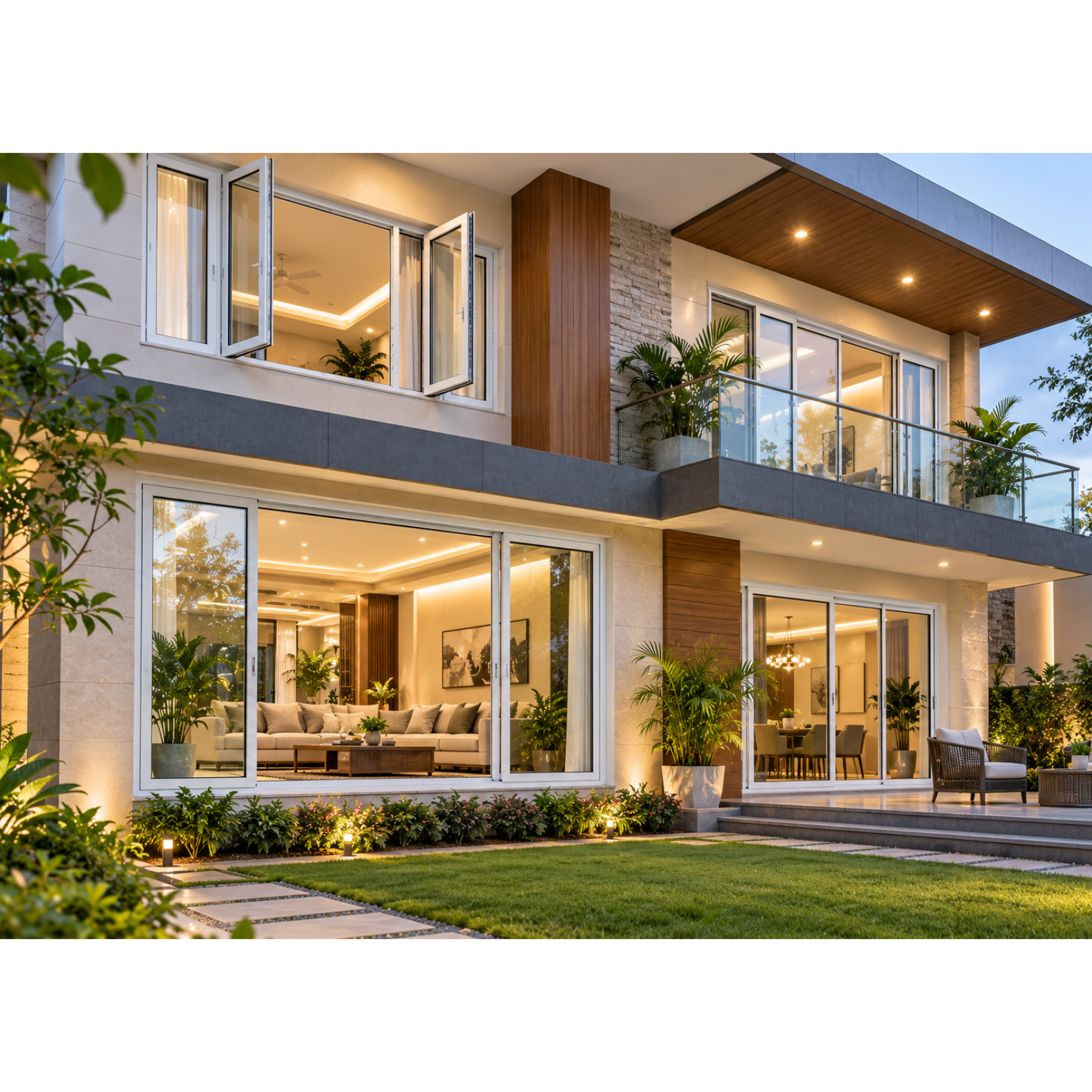
Villa windows have a bigger architectural role than ordinary residential windows.
In a villa, windows influence not only ventilation and daylight but also the appearance of the entire façade.
A living room may need a wide garden-facing opening. Bedrooms need privacy and ventilation. Staircases may benefit from tall fixed glazing. Kitchens require practical operable windows. Balconies need configurations that preserve views without consuming usable space.
This is why selecting uPVC windows for villas in Ghaziabad should begin with the architecture of the property—not with a catalogue of standard window sizes.
The right approach is to plan each opening according to:
Room + orientation + opening size + view + ventilation + glass + privacy + security + maintenance.
This guide explains how villa owners can use different uPVC window configurations throughout the home.
Why Villa Windows Need a Different Design Approach
A typical apartment usually has predefined window openings.
A villa offers considerably more freedom.
During construction, you may be able to decide:
Window width
Window height
Sill level
Number of shutters
Opening direction
Fixed versus operable sections
Glass specification
Mesh integration
That flexibility is valuable—but it also means poor decisions can become permanent architectural compromises.
Instead of using one identical window everywhere, create a room-by-room window schedule.
Why Consider uPVC Windows for Villas?
uPVC is commonly considered for residential windows because it can provide:
Low routine maintenance
Multiple opening configurations
Compatibility with different glazing options
Custom fabrication
Mosquito-mesh integration
Clean contemporary appearance
No routine repainting
But the frame material alone does not determine performance.
A villa window should be evaluated as a complete system consisting of:
Profile + reinforcement + glass + hardware + seals + fabrication + installation.
1. Casement Windows for Villa Bedrooms
Casement windows are among the most versatile configurations for bedrooms.
The shutter is hinged and can open relatively widely.
This makes them useful where natural ventilation is important.
A typical bedroom configuration could include:
Fixed | Casement
or
Casement | Casement
depending on the width.
Casement windows can work particularly well for villa bedrooms facing gardens, side setbacks or internal courtyards.
2. Sliding Windows for Wide Openings
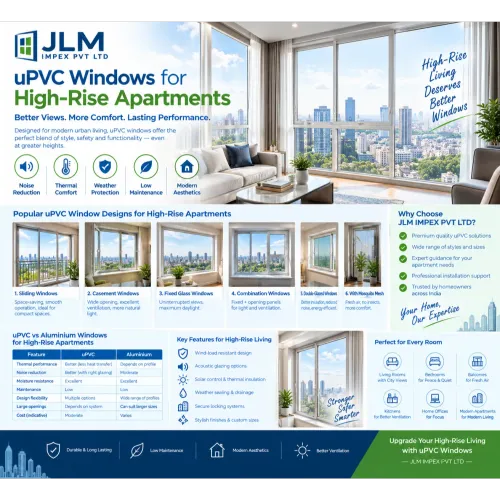
Sliding windows are useful where you want larger openings without projecting shutters.
They can work well for:
Living rooms
Balcony-facing bedrooms
Family lounges
Dining rooms
Because shutters move horizontally, furniture can be placed relatively close to the window.
For wider openings, 3-track or multi-panel configurations may be considered according to the system.
3. Fixed Windows for Views and Daylight
Not every villa window needs to open.
Fixed windows can be highly effective in spaces where the priority is:
Daylight
Exterior views
Architectural impact
Consider fixed glazing for:
Staircases
Double-height spaces
Entrance areas
Garden-facing living rooms
Selected upper-level openings
Because there is no opening sash, fixed glazing can also provide a clean visual appearance.
But exterior cleaning access should always be considered.
4. Fixed + Casement Combination Windows
One of the most practical strategies for large villa openings is combining fixed and operable sections.
For example:
Fixed | Casement | Fixed
The fixed sections maximise glass.
The casement section provides ventilation.
This can look cleaner than dividing a wide opening into many identical opening shutters.
5. Fixed + Sliding Configurations
For wide living-room openings, another possibility is:
Fixed | Sliding | Sliding | Fixed
This provides large glazed areas toward the sides while maintaining an operable central section.
The exact configuration depends on structural opening width and system limitations.
6. Tilt-and-Turn Windows for Premium Bedrooms
Tilt-and-turn windows provide two opening modes.
Tilt
The sash opens partially from the top for controlled ventilation.
Turn
The sash opens more fully for stronger ventilation and cleaning access.
This can be useful for:
Master bedrooms
Home offices
Premium guest rooms
However, inward opening requires adequate interior clearance.
7. Top-Hung Windows for Bathrooms
Bathrooms require a different approach.
Privacy and ventilation usually matter more than exterior views.
A top-hung uPVC window with privacy glass can be a practical option.
It can provide controlled ventilation while preserving privacy.
Depending on layout, consider:
Frosted glass
Top-hung opening
Mosquito mesh
Exhaust ventilation
8. Kitchen Windows
Villa kitchens can benefit greatly from natural light.
Common options include:
Sliding windows above sinks
Casement windows on free walls
Fixed + opening combinations
Top-hung ventilators
Coordinate the window with:
Sink + faucet + countertop + cabinets + hob + chimney.
9. Staircase Windows
Staircases offer an opportunity to introduce architectural glazing.
Tall fixed windows can bring daylight into the centre of the villa.
However, don't create inaccessible glass simply for appearance.
Consider how both surfaces will be cleaned.
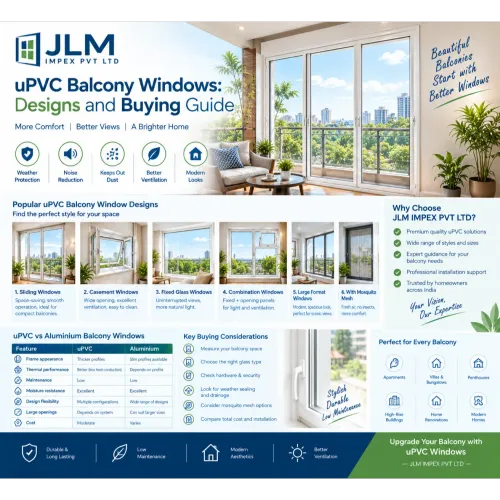
10. Balcony Windows
Balcony windows should preserve the relationship between indoor and outdoor areas.
Sliding configurations can work particularly well because they don't require swing clearance.
Where mosquito protection is important, compatible mesh can be incorporated.
Garden-Facing Living Rooms
A villa living room facing a garden is one of the best places to use larger glazed areas.
Instead of filling the wall with many narrow shutters, consider fewer, well-proportioned divisions.
The goal may be to maximise:
Garden view
Natural light
Visual openness
while retaining selected sections for ventilation.
Double-Height Living Rooms
Double-height spaces require special planning.
Very tall glazing may need to be divided into appropriate panels based on:
Structural opening
Glass dimensions
Frame system
Reinforcement
Installation access
Don't assume that a conventional bedroom window system can simply be stretched vertically.
Villa Façade Design
Windows strongly influence façade proportions.
Before fabrication, look at the complete elevation.
Ask:
Do window head levels align?
Are vertical divisions consistent?
Are some windows unnecessarily fragmented?
Does the frame colour work with the façade?
Do fixed and opening panels look balanced?
Good villa-window design should look intentional from both inside and outside.
White vs Coloured uPVC Windows
White is versatile and works with many architectural styles.
Depending on the selected profile system, laminated finishes may also be available.
Consider how the window colour interacts with:
Exterior stone
Paint
Wood finishes
Railings
Interior furniture
Don't select colour from a tiny sample alone.
Glass Selection for Villas
Different rooms can use different glass.
Clear Glass
Useful for gardens and attractive exterior views.
Frosted Glass
Suitable for bathrooms and privacy-sensitive areas.
Toughened Glass
May be considered according to panel size, location and safety requirements.
Laminated Glass
May provide additional safety characteristics and can form part of an acoustic strategy.
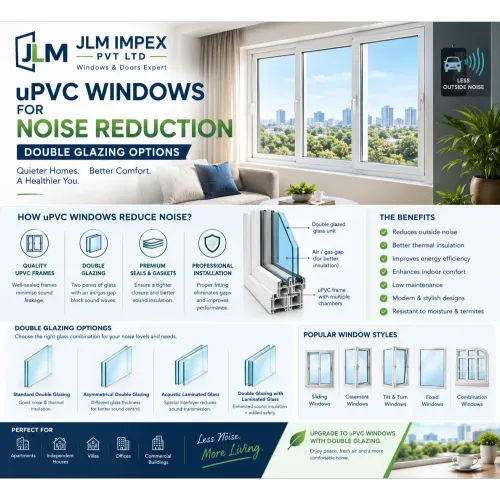
Double Glazing
Can improve thermal and acoustic performance compared with basic single glazing when used within a suitable system.
Low-E or Solar-Control Glass
May be considered for strongly sun-exposed openings.
Don't Use the Same Glass Everywhere
A north-facing bedroom and west-facing living room have different conditions.
Similarly, a road-facing bedroom may need a different acoustic strategy from a quiet garden-facing room.
Create a glass specification by zone.
Villa Windows and Ghaziabad Summers
Large glass areas can increase solar heat gain when strongly exposed.
This does not mean large windows should be avoided.
It means they should be designed intelligently.
Consider:
Orientation
Shading
Roof projections
Balconies
Curtains
Glass specification
Architectural shading can often work together with glazing.
Noise Reduction for Road-Facing Villas
If the villa faces a busy road, discuss noise requirements before selecting glass.
Effective acoustic performance depends on:
Glass + frame + seals + window type + installation.
Avoid treating “uPVC” as synonymous with “soundproof.”
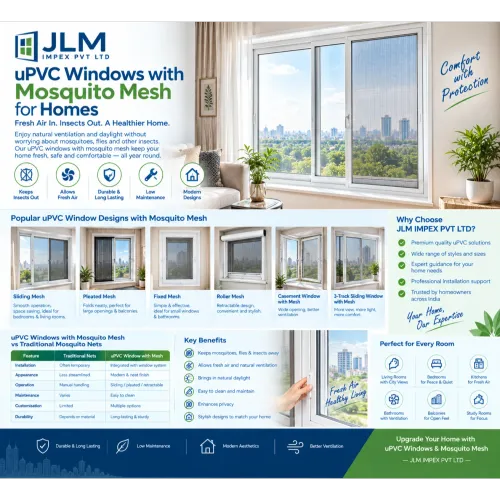
Mosquito Mesh
Villa owners often want to keep windows open during pleasant weather.
Compatible mosquito mesh can be useful for:
Bedrooms
Kitchens
Living areas
Balconies
Plan mesh with the original configuration.
Security
Ground-floor villa windows need additional consideration.
Review:
Locks
Hardware
Glass
Accessible opening size
Grilles if required by the homeowner
Mosquito mesh is not a security system.
Drainage and Weather Protection
Exterior windows are exposed to rain.
The window and surrounding opening should account for:
Frame drainage
Sill design
Exterior slope
Perimeter sealing
Installation quality is particularly important.
Room-by-Room Villa Window Configuration
| Area | Configuration to Consider |
|---|---|
| Living room | Fixed + sliding/casement |
| Master bedroom | Casement / tilt-and-turn |
| Other bedrooms | Casement / sliding |
| Kitchen | Sliding / casement |
| Bathroom | Top-hung / privacy window |
| Staircase | Fixed glazing |
| Balcony | Sliding |
| Study | Casement / tilt-and-turn |
This is a planning framework, not a universal specification.
Common Villa Window Mistakes
1. Using the Same Window Everywhere
Different rooms have different needs.
2. Creating Too Many Frame Divisions
Excessive divisions can reduce the visual openness of large windows.
3. Making Opening Shutters Too Large
Large shutters become heavier and place greater demands on hardware.
4. Ignoring Sun Direction
A west-facing glass wall needs more thought than a shaded opening.
5. Forgetting Mosquito Mesh
Plan it before fabrication.
6. Selecting Glass at the End
Glass should be part of the original design.
7. Ignoring Cleaning Access
Especially for staircase and double-height glazing.
What Determines the Price of Villa Windows?
Villa-window pricing depends on:
Total window area
Profile
Configuration
Number of shutters
Glass
Reinforcement
Hardware
Mesh
Colour/finish
Installation complexity
Large villa projects should ideally be quoted with a window schedule rather than one vague per-square-foot rate.
Questions to Ask Before Ordering
Ask the supplier:
Which profile system is proposed?
What reinforcement is used?
What glass is specified?
Which windows are fixed?
Which windows open?
Which hardware is included?
Where is mosquito mesh provided?
How is drainage handled?
What is included in installation?
What warranty and after-sales support apply?
Why Choose JLM IMPEX for uPVC Villa Windows in Ghaziabad?
JLM IMPEX manufactures customised uPVC doors and windows for residential applications.
For villa projects, window configurations can be planned room by room according to opening dimensions, architecture, ventilation, daylight, glass, mesh and exterior exposure.
This approach is particularly valuable for independent houses and villas because the openings are often customised rather than standardised.
Final Thoughts
Choosing uPVC windows for villas in Ghaziabad should be treated as part of architectural planning.
Don't ask:
“Which one window should I use throughout the villa?”
Instead ask:
“What should this particular window do?”
A bedroom window may prioritise ventilation.
A staircase window may prioritise daylight.
A living-room window may prioritise views.
A bathroom window may prioritise privacy.
Once each opening has a purpose, choosing the right configuration becomes much easier.
Frequently Asked Questions
1. Which uPVC windows are best for villas?
There is no single best configuration. Casement, sliding, fixed, tilt-and-turn and combination windows suit different areas.
2. Are large uPVC windows suitable for villa living rooms?
They can be, provided panel dimensions, reinforcement, glass and hardware are appropriately specified.
3. Which window is best for villa bedrooms?
Casement and tilt-and-turn windows can provide good ventilation, while sliding windows can be useful where space is limited.
4. Can I use fixed windows in a villa?
Yes. They are particularly useful where daylight and views matter more than ventilation.
5. What window should I use for bathrooms?
Top-hung or other operable privacy windows can work well depending on the layout.
6. Is double glazing necessary throughout the villa?
Not necessarily. It should be evaluated according to thermal, acoustic and budget requirements.
7. Can uPVC windows reduce road noise?
Suitable glazing, sealing and installation can contribute to noise reduction when windows are closed.
8. Can mosquito mesh be integrated?
Yes, depending on the selected configuration.
9. Which windows are suitable for staircases?
Fixed glazing can provide excellent daylight, but cleaning access and safety should be considered.
10. Should all villa windows use the same glass?
No. Glass can be selected according to room, orientation, privacy and performance requirements.
11. Can I use coloured uPVC?
Finish options depend on the selected profile system.
12. How should I plan ground-floor window security?
Consider locks, hardware, glazing and accessibility as part of the design.
13. What should be finalised first: windows or interiors?
Window opening dimensions and operating configurations should ideally be coordinated during architectural planning, before fixed furniture interferes with them.
14. What determines villa-window cost?
Area, profile, glass, configuration, reinforcement, hardware, mesh, finish and installation all influence cost.